
Monday, 19 November 2012
Trains, Maps and the Politics of Cartography - Chorleywood Lit Fest Part II
Chorleywood is a town shaped by the London Underground, and in particular by the Metropolitan Railway Company. So it's fitting that the first event to promote Underground: How the Tube Shaped London, the book to mark the 150th anniversary of the Underground, should take place at this year's Chorleywood Literary Festival.
This is not, as Sam Mullins, one of the book's co-authors, is quick to point out, a book for railway geeks. Rather, it's a social history of London as it has been moulded by the building of the Underground.
The first underground line, the Metropolitan Railway, was built to connect the mainline terminuses along the Euston Road. It was, simply, a steam railway built underground and Mullins leaves the audience in no doubt just how noxious that was. The Yorkshire Post described the atmosphere as "leaving one feeling as if one has been chewing lucifer matchers." A mining engineer, overcome by the smoke, recorded fleeing to an apothecary to obtain a tincture for relief. When he asked the apothecary if this was a common occurrence, he was told, "Bless you, sir, sometimes we have twenty cases a day."
When the Circle Line was built, more than twenty years later, it required the newly built Embankment to be dug up all over again. But what really allowed the Tube to take off, were three technical innovations - safe methods of deep tunnelling, the invention of lifts and the invention of electric locomotives.
By the early 1900s, most of the lines we know now had been completed. Some of the recognisable features of design were appearing too, such as the style of writing Underground with a dropped cap for the first a last letter. But it was Frank Pick, CEO of London Transport from 1933, who really created the familiar look of the Underground. He commissioned the world's first san serif typeface - the Johnston - still in use today, the familiar posters, the Art Deco station design - and of course, Harry Beck's iconic tube map.
This was a period when the Underground was at the cutting edge of design, modern, innovative and flourishing. But it wasn't to last. The use of private cars meant that revenue from buses, which had always subsidised the Tube, was declining. For decades after the Second World War, the Tube suffered from underinvestment. Mullins took us through some of the low points in the Tube's history, culminating in the devastating King's Cross Fire of 1987.
This proved something of a turning point, and Mullins' talk culminated with a postscript to the book - the story of London Underground's role during the 2012 Olympics. At its peak during those two weeks in the summer, the Tube carried 4.7 million passengers a day, up from its previous record of 3.2 million. Before the fact, most commuters would have said it was impossible. But then again, back in 1925, someone described rush hour at Finsbury Park as: "Pandemonium, something like a free fight, where men and women fight like rugby players to make their way home."
Some things never change.
Harry Beck's Tube Map is a useful reminder that a map doesn't need to be - and in fact never can be - a literal representation of the world outside. Jerry Brotton's fascinating book, A History of the World in Twelve Maps, looks in particular at the history of World Maps and shows how the way the world is represented is conditioned by who makes the maps and what they are for.
He begins his talk by showing us two maps - a Babylonian clay tablet from 500BC which is the oldest known map of the world, and the start-up image from the 'geo-spatial application,' Google Earth. Far apart as they are, they share two things. First, they attempt to show the world from a god-like perspective, looking down from above. Secondly, they place the viewer's actual location at the centre of the world.
The next maps Brotton shows us are copies of the ones created by Ptolemy in the Library at Alexandria around 150CE. Ptolemy knew very well that the world was a globe, and that a globe could not be represented accurately on a flat piece of paper. He developed two types of projection. The first started with a pin at the North Pole and drew fan-like lines of longitude. The second, more accurate but more difficult, had curved lines of longitude and created more of an illusion of the earth as a sphere. And indeed, although Africa fills the bottom of the map and the Indian Ocean is shown as a vast lake, in many ways, Ptolemy's map doesn't look unfamiliar.
Not all maps place the viewer at the centre of the world. The 13th Century Hereford Mappa Mundi places east - the supposed location of the Garden of Eden - at the top of the map and Hereford near the bottom. Man's progression is towards the Kingdom of God.
The world's first known globe is an interesting oddity of timing. It was made in Nuremberg for a merchant, who has it annotated with details of what can be traded where and for how much. But it was made in 1492 - just months before Columbus sailed to America - and thus is maintains Ptolemy's erroneous assumption that it is but a short hop across the ocean from Portugal in the west to China in the east.
Mercator was the first cartographer since Ptolemy to produce an entirely new projection. His aim was to produce a map that could be used by navigators who were interested in sailing east-west. The extremes of north and south were frozen and unnavigable, so he used a projection that maintained the greatest accuracy nearest to the equator.
It wasn't until the 20th Century that Mercator's projection was seriously challenged. The Peters projection, used today by NGOs and the UN (and famously in an episode of The West Wing) aims to maintain equality of area and get rid of distortions that appear to exaggerate the importance of North America and Western Europe.
Which brings us back to the present day and the emergence of GPS mapping and of Google Earth in particular. Brotton was allowed access to the mapmakers at Google, "but when they saw what I wrote, they stopped returning my calls."
He sees satellite mapping as the biggest revolution in cartography since the development of print maps, and a revolution that is still in its infancy. For him, it encapsulates the some of the tensions that have always existed in mapmaking. Should maps be produced mathematically, based on scientific measurements, or should they be derived from local knowledge? Who should control the production of maps?
Brotton believes that cartographers in the last decade have abrogated responsibility for mapmaking and allowed corporations like Apple and Google to take over. On the one hand, as a questioner from the audience makes clear, satellite mapping has broken political barriers and provided access to maps in places, like Siberia, where paper maps have never been permitted. On the other hand, the digital divide is made wider where paper maps cease to exist. And ultimately the corporations' intention, like that of the merchant from Nuremberg, is to maximise the opportunity to sell things.
Brotton's message is, "Be sceptical. Don't let yourself imagine that these maps are any less biased, any less selective in what they show you and what they don't than the ones that have gone before." Even that start-up image on Google Earth, the one that evokes the famous 'Earth Rise' photograph, he believes has been chosen cynically, for the way it manipulates our emotions.
Beware, as the old maps said. Here be dragons.
If you would like to read about Howard Jacobson, Clive Stafford Smith or Ben Elton at the Chorleywood Literary Festival, look out for the December edition of Words with Jam.


Friday, 16 November 2012
Rising Stars at the Chorleywood Lit Fest
One of the highlights of the annual Chorleywood Literary Festival, now in its
seventh year, is its Rising Stars slot,
showcasing new and lesser known talents.
The authors chosen are always those that Sheryl Shurville and Morag
Watkins – owners of Chorleywood
Bookshop and organisers of the festival – are genuinely excited about, and
their enthusiasm shines through.
It’s a free event and an informal atmosphere, allowing the
audience – many of whom are members of creative writing groups – to quiz the
three authors, who this year are Erin Kelly, Nell Leyshon and Evie Wyld.
Erin Kelly has
published two psychological thrillers – The Poison Tree and
The Sick Rose – has a third one coming out
in January and is racing to finish a fourth against the very hard deadline of
the birth of her second child.
Kelly worked as a journalist for ten years before she
“plucked up courage” to try fiction. “The Poison Tree is about a summer of love that went horribly
wrong. It opens with a man being
released from prison. We know he
killed two people. The mystery is
about who he killed and why.”
Finishing the book while on maternity leave, she prepared a
drawer for all the rejection slips she expected and sent it out into “a great
big void of silence.”
Kelly eventually found an agent and there was an initial
flurry of excitement as the book was sent out to publishers. “They liked it but they didn’t know how
to sell it. It wasn’t crime, because it had no detective. It wasn’t women’s fiction because of
the crime. It wasn’t literary
fiction because of the plot… plus I’d given it this clever post modern cliff
hanger ending.”
Eventually Kelly rewrote that troublesome ending and the
book went to auction. She likes, she says, to set books in locations that are
at a slight remove from society.
She is addicted to programmes like Coast and mines them for ‘those five minute glimpses of personality’ that
often inspire her characters.
The Poison Tree is
currently being filmed by STV, a project Kelly has no involvement with. As it happens, the interiors for one of
the key locations were filmed in Chorleywood and the owner of the house is in
the audience. “They put us up in a
hotel for eight days, spent three days set dressing then five days
filming.” “Did they put it all
back again afterwards?” someone asks.
“It wasn’t entirely
satisfactory,” the owner says.
“That’s a little like a feel about my book,” says Kelly wryly.
Nell Leyshon is a
dramatist who has had plays produced for the BBC and at The Globe. “I wrote three novels that I discarded
and then got stuck on the fourth. Then I thought I’d try and write a radio play
and as soon as I began to write dialogue, it felt right.”
The Colour of Milk is
her first return to novel writing, and it’s no surprise that it has an
incredibly strong voice. The book is narrated by Mary, a young woman in rural
Somerset in the mid 1800s, who is being taught to read and write and in so
doing is given the means to tell her own story.
“I have always been interested in the people who have no
voice, who appear in other people’s stories and never get to tell their
own. I was fascinated by someone
who is illiterate but who has so much intelligence and vitality.”
Leyshon is the only one of the three to read from her own
book. She gives Mary a strong
Somerset accent and a soft voice with an edge to it that draws the audience in
and has them sitting on the edge of their seats.
Leyshon continues to write both novels and drama. (She was playwright in residence at
this year’s Hay Festival and this week the BBC is broadcasting on of her plays
on Woman’s Hour.)
“I am always facing deadlines. I begin the day with a walk by the sea, then I sit at my
desk and work. I might begin with
‘virgin writing’ and then switch to editing another project in the
afternoon. When I was working on The
Colour of Milk, I sometimes had the laptop
next to the cooker while I cooked dinner.”
She clearly has an exceptional work ethic – and she has the
perfect answer to anyone who says they can’t write unless inspiration hits
them. “I once tried an experiment
where I made a note at the top of the page whether the words were flowing or
whether was I struggling. When I
looked back at it afterwards, there was no difference in the quality. It was all about how I was feeling at
the time.”
Evie Wyld grew up
partly in London and partly on her family’s sugar cane farm in Australia. Her novel, After the Fire, the Still
Small Voice, is about three generations of Australian men affected
by war, and is loosely based on the experiences of her grandfather, uncle and
cousin.
“My grandfather fought in the Korean War and my uncle was
drafted into the Vietnam War and was very damaged by it. But it’s not about them. It’s fiction.”
The farm, seven hours north of Sidney, is “like something
from the 1950s. The men drive
tractors in their underpants and no shoes. My uncle only wears shoes when he has to, which means
funerals but not weddings.”
Wyld studied short story writing at Goldsmiths College and
fell into novel writing after an agent expressed at interest when one of her
stories was published online. Writing a book takes her a long time. “I start from the middle and work out. When I am getting the first draft down,
I have to work first thing in the morning, before I’ve spoken to anyone. But then most of the work is in editing
and cutting. I write a lot more
than I use.”
None of the three authors writes to a detailed plan. “Why would you write it if you knew
what was going to happen?” says Leyshon.
Kelly has a basic skeleton, “but then I write in a patchwork.”
Have they ever been asked to change something they really
didn’t want to?
Not really, is the response. Kelly contrasts it to journalism, when a commission is
anonymous and you can find your piece being published under a different
headline and with an unrecognisable slant. “With a novel, an editor chooses your book because they like
they like they way you write.”
Leyshon agrees. “It’s about finding someone you think you can
work with. In my case I chose
someone scarily honest and direct.”
“My American publisher did tell me I had too many toilet
scenes,” says Wyld. “But I told
him I’m half British, half Australian, so what did he expect?”
The US version of The Poison Tree translated the British words into American, says
Kelly. “They told me the cultural
flow doesn’t work both ways. But readers told them they didn’t like being
patronised. It hasn’t happened
again.”
All three recognise the influence that big distributors like
Tescos have on cover design. Wyld admits she has been lucky. She has a friend who is a
well-recognised freelance design that her publisher was happy to work
with. He designed her hardback
cover, a collage of etchings. Her
paperback cover is based on her own photograph of her family farm. But the American cover she didn’t like
at all. “But I figured they knew
their own market.”
Leyshon loves the woodcut image on the hardback edition of The
Colour of Milk. But the initial proposal
for the paperback cover included a sexualised image that was totally
inappropriate. She did get that
changed. “But you can only can
push so far. You don’t want to get a reputation.”
Kelly, too, loved the covers of her first two books. The
design for the latest book, she says, is more garish. “But believe me, no one
is more alert to the presence of my books in a shop than I am, and I have to
admit these covers don’t stand out.”
The bookshop is offering a bundle of three books from the
three authors for £20. By now I am
far too intrigued to turn it down.
I leave the event with my purse lighter and my bag heavier. Now I just need enough self-discipline
not to start reading until I have finished work…
If you want to read more
about the Chorleywood Literary Festival, look out for the December issue of
Words with Jam.
Wednesday, 10 October 2012
David Mitchell
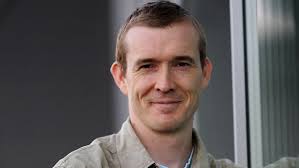 Interview by JJ Marsh, with Perry Iles. Photography by Libby O’Loghlin
 David Mitchell is widely renowned as one of the greatest British novelists of his generation, garnering comparisons to Tolstoy, Twain, DeLillo and Pynchon among others. He has won the Geoffrey Faber Memorial Prize, the South Bank Show Literature Prize and the Richard and Judy Best read of the Year prize. He has also been nominated for the Guardian First Book Award, the Booker Prize, the James Tait Black Memorial Prize, the Commonwealth Writer's Prize and the Costa Book Award. He has also written the libretto for the opera Wake, which debuted at the Nationale Reisopera in 2010 to great acclaim. Born in 1969, David grew up in Worcestershire and, after several years teaching in Japan, he now lives in Ireland with his wife and their two children. His novel Cloud Atlas has been adapted into a film by Tom Tykwer, Andy Wachowski and Lana Wachowski. You can watch the extended trailer here.
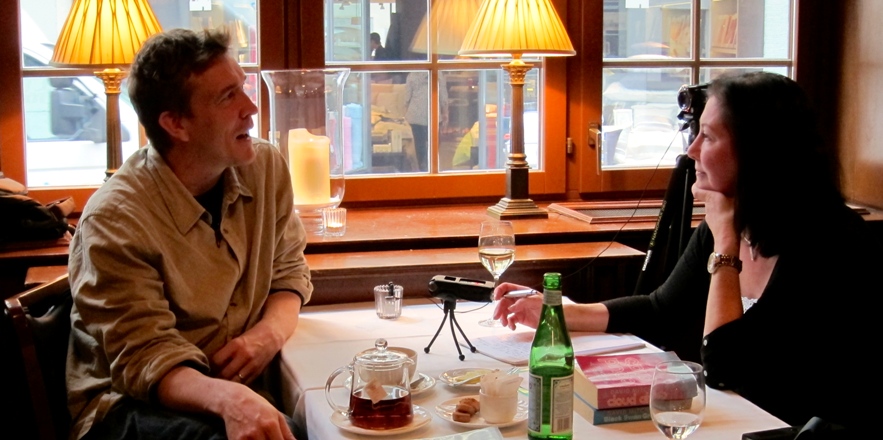
David Mitchell came to Zürich as part of his promotional tour for the German translation of The Thousand Autumns of Jacob de Zoet. Up a cobbled alleyway of the Old Town, in a discreet restaurant, he shared his thoughts on half-full glasses, John Lennon and Transferrable Reality Concreteness.
I was armed with pristine naïvete. I was living in Japan and just did what I heard you were supposed to do – send three chapters and a summary to an agent. I picked one, Mike Shaw at Curtis Brown, because he had the only non-posh name that a bog-standard, state comp-educated kid wasn’t intimidated by. He sounded like he could be a character off Eastenders. I sent him my first novel. Big sections of it were rubbish and I’m now profoundly grateful it wasn’t published. But on the back of that, Mike said, maybe not this time but if you want to send me the next thing you work on ... So I did and that was Ghostwritten. I got a very off-the-rack, unastronomical two-book deal, but it was amazing. This was in the days of fax machines and I still remember the excitement of that fax coming through. It was one of my best ever days. And it’s been like that ever since. Same agency, same publisher and my editor, Carole Welch has been with me since book two.
And Jonny Geller’s your agent now. I interviewed him last year and found his passion for his authors very impressive. Yes, after Mike retired, Jonny took over. And all of his authors have a hard time believing he represents anyone else. We really think he spends all day thinking about us. He’s a very hard-working man.
Two of my favourite books now have cinematic adaptations. Cloud Atlas and Midnight’s Children. Rushdie’s creative influence on the film was immense. What about your relationship with the Wachowskis and Tykwer? How much involvement did you have?
Almost none. The desire for my approval for an early form of the script I do believe was genuine. We met in Cork, and that’s when they discussed foregrounding the reincarnational theme by having the same actor play different ethnicities and genders at points in time. Which you can only do in film. You can’t have actors’ faces in books.
You were happy with that? Absolutely. John le Carré, speaking about the film of Tinker, Tailor, Soldier, Spy, said what I wanted to say. The biggest compliment you can pay is to take the book and interpret it your way. What’s the point in making an audiobook with moving pictures? I want it to be disassembled and reassembled. And they’ve altered some plot lines, to make the Tom Hanks/Halle Berry relationship evolve over time, and that’s fine. It has its own, pure internal logic. It was very hard for the Wachowskis and Tykwer, but my first Hollywood experience has been unusually lucky. They really are artists. With people like that, it’s an honour to be adapted. I wouldn’t be voluntarily praising the film as much as I do if I didn’t respect them and what they’ve done.
And you have a cameo role? Blink and you’ll miss it. I’m in two scenes, and people who think deeply will eventually work it out. When you get the logic, you can work out that I’m a kind of Svengali, a behind-the-scenes manipulator. It’s a sweetly placed cameo for an author.
What sort of fiction do you read? Good fiction (laughs). Sometimes I read work written by friends, it’s getting socially awkward not to. I have a big list of classics to catch up with. And I read things I can use, such as James Meek’s We Are Now Beginning Our Descent. It’s about a war correspondent, and I’m thinking about a character who might overlap.
Characters from your previous pieces turn up regularly in your other books and short stories. Are these thematically representative, or are you just fond of these guys? I’m fond of them; it’s fun. And I like the idea of writing an über-novel and all of my books are chapters in it. And linked with that is my theory of Transferrable Reality Concreteness. If you’ve spent time with a character in work A, and you felt that was a very real place, then when they appear in work B, they bring with them the conviction that any world they appear in is real. Shakespeare did this in the history plays, and Falstaff appears in The Merry Wives of Windsor. There’s even a literary word for this: metalepsis. Sprinkle that one into conversation when you can, then make friends and influence people. So when I bring back characters, it’s like meeting someone you’ve known for years, you have history, you remember where you were when you met them.
Yes, that’s true. It was lovely to meet Jason Taylor again in your short story, Earth calling Taylor. Thank you very much. In my next book, I’ve got Hugo Lamb, who was Jason’s awful cousin, a kind of malign Ferris Bueller. He’s got quite a big part in the new book.
The references and motifs in your work are often musical; Paul Auster’s Music of Chance; Thomas Bernhard’s Der Untergeher; the title of Cloud Atlas itself as a piece by Toshi Ichiyanagi; and two references to Neil Young; the formality of composition and returning to chords, tones and melodic riffs – what’s your relationship with music and literature?
Music is a big part of the world, and I want to put the world into my books. Musicality is a different thing. Language has a musicality, most audibly so when you don’t speak it and you’re undistracted by meaning. Two Turkish ladies talking this morning on the train here from Stuttgart – I don’t speak a word so I heard it more purely. There’s a musicality to individual words, which you do consider when choosing them. Because there’s a difference to when words are spoken and when they’re read.
Like me, you were an English teacher for many years. What did you learn? And how much did that feed your work?
It’s so helpful. It gives you a practical working knowledge where a native speaker only has an unconscious knowledge. It also means you can write non-native speakers a whole lot better, which for me is essential.
Can we talk about cultural influences? I’m especially intrigued by the subtle layers of cultural (mis)understandings and interpretations in The Thousand Autumns of Jacob de Zoet. Japanese, the most indirect of languages, as opposed to Dutch, one of the most direct. And you render all this in English. It’s a conjuring trick.
It was a nightmare, to be honest. I had about eight different dialects to signify language, class and gender. Most languages have a passive voice, and I used that for the Japanese to eliminate the pronouns. We use that when we want to evade responsibility. I wrote a short grammatical constitution, for the Dutch, English, Japanese, educated, pleb and female Japanese. Each has three or four rules, for example, the Japanese don’t contract, or at least not in my book. The Dutch don’t use ‘will’, it’s always ‘shall’, which gives it an archaic patina. And all the time you’re writing under the confining umbrella of historical fiction, so neologisms are out. I discovered the hard way, by reading whole load of Smollett and applying his usages, that it sounds like Blackadder. If you get it right, it sounds patently absurd. You could do it for a few pages but then forget it. So you have to insinuate that they’re speaking as we would have done a hundred years ago. I call this the ‘lest/in case’ dilemma. ‘In case’ is pretty new, so I pushed the Dutch more in a ‘lest’ direction, as we spend more time with them and they’re foreigners to the Anglophone ear. Whereas the English tend to use ‘in case’. But it was a huge problem. Thumping great novel, huge cast and after a while, the reader’s going to think, ‘Hang on, they all have the same voice. Ah, it’s a novel, it’s not real’. Then pop goes the bubble and you’ve lost it.
One of your most astounding achievements is structure. Not just over one book, but your entire canon. Do you choose to break from convention or is the choice of framework more visceral, organic?
With the exception of Cloud Atlas which was there already, they emerge and evolve as the only possible way to get the damn book written.
When you say Cloud Atlas was there already, you’re referring to Italo Calvino’s If On A Winter’s Night A Traveller?
Yes, exactly. With that mirror at the end of it so you go backwards. But you know, Calvino is now best loved now for works like The Baron in the Trees. That’s a lovely idea, lovely story, no tricks. My work is relatively new, so time as the ultimate test has not yet been applied. I’m not sure how these clever postmodern experiments now look or will look in the future.
Are you wary of writers who call themselves postmodernists?
I think there is a danger in buying into a way of writing as cleanly labelled and distinct as postmodernism was in the 80s. The danger is that you’ll age quicker. On the other hand, Midnight’s Children still reads really well. But is that really what we call postmodernist? It has flecks of magical realism and in other ways is quite Dickensian, which I mean as a huge compliment.
Half full or half empty? Pessimism seems to play a great part in your take on the human condition, but it appears to go hand-in-hand with some kind of spiritual redemption on a higher level. Where are we bound?
No dark, no light; no light, no dark. Redemption is important. Over lunch, we talked about Terry Gilliam’s Brazil. I remember watching that as a twelve-year old, expecting something like Close Encounters. I really enjoyed it but at the end, he’s strapped to a chair, he’s delusional and he’s having this awful screaming nightmare about what the film has been. I remember thinking ‘Thank you so much. Not.’ If a thick book, in which you invest many hours of your art-consuming life, ends up sledge-hammering your skull in with bleakness and a total lack of redemption and then expects you to admire the brutality of its honesty, I feel cheated and I want my money back. I know it’s grim up north, and it’s pretty grim down south too, but just gimme some hope. That’s a Lennon quote. Again.
The Number 9 Dream connection?
Yes, as you mentioned, Cloud Atlas is actually a piece by Yoko Ono’s second husband, Toshi Ichiyanagi. Not many people know Number 9 Dream, because it doesn’t feature on the Greatest Hits, but is on the Walls and Bridges album. It’s absolutely glorious, a very superior pop song.
Finally, what have you learned from writing?
More about how to write. An infinite job. Did you read that piece by Julian Barnes, My Life as a Bibliophile? At the end, he talks about the symbiosis between reading and life. He talks about an aphorism; ‘Some people think that life is the thing, but I prefer reading’. He criticises it as slick and meretricious. The more you live, the more intense your reading experience becomes. And vice versa, the more you read about non-existent people, the better potential you have to understand existent people. As for reading, so for writing. To write a consistent character, you need to formulate the laws of consistency in real human beings. And if you can’t find them, at least you need to fumble in the right direction. So to get the writing right, I’ve had to think more deeply about people and what drives our miraculous, bonkers, paradoxical species.
Monday, 8 October 2012
A Tale of York Gardens Library
By Catriona
Troth, the Library Cat.
In the
October issue of Words with Jam, I have written about a number of community
groups either fighting for the survival of their libraries or now actively
involved in running them. Here is
another story to go with those:
York Gardens Library in Wandsworth who, in one of the poorest wards in London, face an eye-watering target for fundraising to keep their library going.
Thea Sherer
from The Friends of York Gardens Library, tells me:
"In 2010 York
Gardens Library and Community Centre was threatened with closure, as a result
of local government cuts. Nearby residents and civic groups came together to
campaign against the decision and support came from across the borough,
including from many people who had never visited this library but recognised
its value to the local community. As a result of a concerted campaign, a compromise
was reached to allow the library to remain open with support from community
stakeholders and volunteers.
 |
| Story Time at York Gardens |
“The library
and associated community centre remains open as a Direct Service Organisation
(DSO) pilot project, with a reduced staff supported by volunteers. The local
community will contribute to the management and day-to-day running of the
library, thus reducing the cost burden on Wandsworth Borough Council.
“Part of the
role of the volunteer group is to raise a significant amount of funds (more
than £70K per annum) to contribute to the operational costs of the building
and services. Wandsworth still provides around £100K per year of funding,
including (reduced) staffing costs. Volunteers support work in the library.
They also develop and run community projects which run in the community rooms
and promote the library and centre."
£70k might
sound like an extraordinary amount for any
community to have to raise, but the scale of the challenge facing the
Friends of York Gardens is made even more apparent if you consider that 60% of
residents on the neighbouring estate are unemployed and more than 40% do not
have English as their first language. Incidents of hidden homelessness and
overcrowding are five times more likely in this ward than the national average.
The area is associated with issues of crime and antisocial behaviour.
Of course
what this means is that the need for library services is greater than ever, and
it is this awareness that is driving the Friends . Access to books and IT at home are both significantly lower
than average and the library is especially important to children and minority
groups.
“The need for
library services here is unquestionable,” Sherer says, “but the way these
services are used may be unconventional. Several volunteer run projects are
bringing more and more children into the library in a number of innovative
ways. The drama club, capoeira group and craft club are all well attended. A
volunteer-run GCSE tutoring course, run for free for local teenagers, has been
really successful. These activities provide great things to do for local
children but also increase footfall in the library itself.”
The £70k per
annum fundraising challenge will be met in part by charitable fundraising and
in part through letting of community rooms.
“Staff and
volunteers are working very hard to increase room bookings which will help a
lot. The volunteers in the Friends group are all rather stretched and so
committing a lot of time to fundraising activities is a real challenge,” says
Sherer. “Major library functions are all still completed by council library
staff. And some very dedicated individual volunteers have been tremendously
supportive, particularly when it comes to running community projects. But
getting enough volunteers with sufficient commitment to assist in the library
on an ongoing basis has proved a challenge.”
The group has
also has to manage its partnership with Wandsworth Borough Council.
“The first
twelve months were difficult while we found the best ways of working together,”
Sherer says. “There were many operational aspects related to the library and
the building where it was unclear, or where there was disagreement, on whether
the council had decision making power or the volunteer/Friends group.
“For example,
the setting of the charges for the community to hire out rooms within the
building has always been set by the council and were uncompetitive and too high
for community groups. Some flexibility has now been added, which has eased the
situation and allowed more community organisations to use the rooms. However,
the Friends group believe that more power to set these charges needs to be
given to the volunteer organisation. It also took significantly longer than
originally planned for the council to employ a new library manager. The project
has been given significant impetus since the manager was appointed. “
In spite of
everything, Sherer remains upbeat. And the dedication of determination of the
Friends of York Gardens Library is unquestionable. But it is hard not to conclude that this is a community that
has been forced into an impossible position. As Sherer says, “It will remain to be seen whether the
fundraising target is really achievable and how the council will respond if it
is not met.”
In the main
article in the magazine, I interview Jim Brooks of the Friends of Little
Chalfont Library , who has advised so many community groups around the country
. Brooks suspects that some Councils may be setting community libraries up to
fail. “They’ve worked out that closing libraries will lose them votes,” he
says. “So they set a bunch of volunteers up with a building that’s falling
apart, starve them of key resources and then when the libraries fail, they will
be able to say – well, we tried the volunteer route but it didn’t work.”
Let’s hope Wandsworth
and York Gardens don’t fall into this trap.
To read the
main article in the October issue of Words with Jam, go to our website and
subscribe FREE to the online edition.
Friday, 5 October 2012
Writing the Landscape
by Catriona Troth
A few weeks ago, I wandered,
more or less by chance, into the Writing
Britain exhibition at the British Library. From their vast collection
of books, manuscripts, audio and photographs, the Library had assembled a panoramic
view of how writers from the Middle Ages to the present day have represented
the British landscape.
It began by evoking rural,
agricultural landscapes - from ancient stories of the Green Man to a recording
of Stella Gibbons' talking about Cold Comfort
Farm and a hand drawn map of the locations in Winifred Holtby's South Riding. From there, you
moved on to the section entitled 'Dark Satanic Mills,' the literature of
factories and labour from Elizabeth Gaskell's North and South, set in the early days of the industrial revolution
to Ted Hughes' collaboration with the photographer Fay Godwin, charting the
decay of the old mills and chimneys.
The ‘Wild Places’ section of
the exhibition was screened with panels of white fabric marked with steep
contour lines. Here were manuscripts from the Romantic Poets, a copy
Lorna Doone and a recording of Daphne du Maurier describing how she first
stumbled on Jamaica Inn on her horse, seeking shelter from a storm.
‘Beyond the City’ celebrated
suburbia in books such as The Rotters
Club, Metroland and The Buddha of
Suburbia. In the section on London, detailed street maps covered
surfaces around the exhibits and hung from baffles above your head. The
most immersive experience of all was in ‘Waterlands’, where video screens
showed images of coasts, rivers and lakes, and you were surrounded by the sound
of lapping waves.
All this made me think about
books that evoke the British landscape for me. I was born in Scotland,
but I grew up in Canada, so for many years my images of Britain were almost
entirely drawn from what I read.
It began, I suppose, with The Borrowers. I never really
understood why I adored Mary Norton's stories so completely, until as an adult
I bought an omnibus edition with a foreword in the form of a letter she had
once written to a young fan. In it she described growing up as the
short-sighted sister of three long-sighted brothers, forever focused on the
tiny details of the Leicestershire hedgerows as her brothers vainly tried to
show her hawks wheeling in the sky. I had grown up as the short-sighted
daughter of a long-sighted mother, and I knew exactly what she meant.
After The Borrowers came Swallows
and Amazons. I fell in love with Ransome's Wild Cat Island and
Katchenjunga ten years before I ever set foot in the Lake District, and I still
get a thrill when I catch a glimpse the steamer on Windermere that is
recognisably Captain Flint's Houseboat.
Unlike his Lake District, which
is a conflation of Lake Windermere and Coniston Water, Ransome's portrayal of
the Norfolk Broads is so accurate you can follow the adventures of the Coot Club step by step on a map.
My husband would have done well to have read about Tom's narrow escape
passing through Yarmouth as the tide was running out before he attempted the
same with some friends from university. I have never been to the salt
marshes around Harwich, but from Secret
Water, I have a vivid image of the 'Mastadon' paddling over the soft mud
flats wearing something like flat wooden snow shoes, and of Titty, Roger and Bridget
almost trapped on the Wade as the tide sweeps back in.
I live not that far from the
Thames now, but before I ever set foot in them, I knew Marlow and Maidenhead,
Cookham and Goring from the lyrical descriptions in Jerome K Jerome's Three Men in a Boat (which he would
immediately undermine with some piece of grumpy absurdity that would have me
howling with laughter).
We went through Maidenhead quickly, and
then eased up, and took leisurely that grand reach beyond Boulter’s and Cookham
locks. Cliveden Woods still wore their dainty dress of spring, and rose
up, from the water’s edge, in one long harmony of blended shades of fairy
green. In its unbroken loveliness this is, perhaps, the sweetest stretch
of all the river, and lingeringly we slowly drew our little boat away from
its deep peace.
Oxford was painted for me by
Dorothy Sayers in Gaudy Night (in
colours that were probably idealised even in 1935).
Mornings in Bodley, drowsing among the
browns and tarnished gilding of Duke humphrey, snuffing the faint, must odour
of slowly perishing leater, hearing only the tippety-tap of Agag-feet along the
padded floor; long afternoons, taking an outrigger up the Cher, feeling the
kiss of the sculls on unaccostomed palms…
There are places I have never been, or
only passed through, that have been made real for me through the pages of a
book. There can surely be no better evocation of Eastern Scotland than
William Grassic Gibbons' Sunset Song
(which is surely impossible to read without hearing it in a soft, Aberdeenshire
accent).
But for days now the wind had been in
the south, it shook and played in the moors and went dandering up the
sleeping Grampians, the rushes pecked and quivered about the loch when its
hand was upon them, but it brought more heat than cold, and all the parks
were fair parched, sucked dry, the red clay soil of Blawearie gaping open
for the rain that seemed never-coming.
The Clean Air Act came in a few years
after I was born, so I never experienced the London Peasoupers that blighted my
father's childhood. But I've lived through them in the opening passages
of Dickens' Bleak House.
Implacable November weather. As much
mud in the streets as if the waters had but newly retired from the face of the
earth, and it would not be wonderful to meet a Megalosaurus, forty feet long or
so, waddling like an elephantine lizard up Holborn Hill. Smoke lowering down
from chimney-pots, making a soft black drizzle, with flakes of soot in it as
big as full-grown snowflakes - gone into mourning, one might imagine, for the
death of the sun. Dogs, undistinguishable in mire. Horses, scarcely better;
splashed to their very blinkers...
Fog everywhere. Fog up the river, where
it flows among green aits and meadows; fog down the river, where it rolls
defiled among the tiers of shipping and the waterside pollutions of a great
(and dirty) city…
Books shape the way we remember
too. I was born in Edinburgh, but today the city for me is a joint
creation of Ian Rankin and Alexander McCall Smith. My mother was
transported back to Anglesey, the home she left more than sixty years ago, by
the descriptions in Gillian Hamer's Charter. And nothing, but
nothing, has brought back what it felt like to arrive back in Britain from
North America in the mid-seventies than the opening chapter of Bill Bryson's Small Island.
Surprisingly,
a writer does not have to be a native or even long-term resident to be able to
conjure a time and place to vivid life.
The author of The Guernsey
Literary and Potato Peel Pie Society only ever spent one day stranded by
fog on the island. Sarah Waters' The Night Watch helped me to understand, as nothing else had, the
realities of living through the London Blitz, though she was born in twenty
years after the War ended. Michel Faber’s portrayal of the seamier side of
Victorian London in The Crimson Petal and
the White is as beguiling as Dickens’.
I guess the lesson for writers here is
– write about the places you love, yes; make others love them too. But don’t be afraid to set your imagination
free. The landscapes of the mind are the best ones of all.
Thursday, 20 September 2012
Podcast: just a taste of our interview with David Mitchell
Film adaptations of literary work and the relative involvement of the author are under much discussion this autumn: Salman Rushdie's Midnight's Children, Jonathan Safran Foer's Extremely Loud and Incredibly Close, and David Mitchell's Cloud Atlas. In our podcast, an extract from an exclusive interview for Words with JAM, David Mitchell discusses the cinematic representation of a book considered as 'unfilmable'.
Listen here and whet your appetite for the October issue of the magazine, where you will be able to read the full interview.
http://wordswithjam.podomatic.com/player/web/2012-09-20T12_41_35-07_00
Listen here and whet your appetite for the October issue of the magazine, where you will be able to read the full interview.
http://wordswithjam.podomatic.com/player/web/2012-09-20T12_41_35-07_00
Friday, 14 September 2012
An African Julius Caesar
If you visit Shakespeare: staging the world at
the British Museum, the last object you will see as you walk round is the
Robben Island ‘Bible’.
This is a copy of The Complete Words of Shakespeare owned by
Sonny Venkatrathnam, a prisoner on Robben Island at the same time as Nelson
Mandela. In order to be able to lend the
book to the other prisoners, Venkatrathnam disguised its cover with Divali
cards sent to him by his family. The book
was then passed from hand to hand, and the prisoners wrote in the margins next
to passages that meant something special to them.
Nelson Mandela signed his name next to a
passage from Julius Caesar:
Cowards die many times before
their deaths;
The valiant never taste of death but once.
Of all the wonders that I yet have heard,
It seems to me most strange that men should fear
Seeing that death, a necessary end,
Will come when it will come.
The valiant never taste of death but once.
Of all the wonders that I yet have heard,
It seems to me most strange that men should fear
Seeing that death, a necessary end,
Will come when it will come.
Anthony Sampson, Mandela’s biographer, wrote, “in South
Africa the play had a deeper resonance, for it vividly described how an
oppressed people can realise their potential against tyranny and escape from
their sense of inferiority.”
It was this that inspired Gregory Doran of the RSC to
produce a Pan-African’ Julius Caesar
as part of this summer’s World Shakespeare Festival. I was lucky enough to get tickets for one of the
last performances in London before they begin a short national tour.
The Noel Coward theatre is quite small – with three gilded tiers
of seats above the stalls, but shallow, so none are very far from the
stage. The set was a stone archway and a
series of steep stone steps, allowing the action to take place at different
levels. As we walked in, well before the play was due to start, there were
already actors on the stage – the crowd in an African market shortly before an
election. A band was playing, men were
dancing. There were flags and election
posters – a festive mood.
The act of transplating a play like Julius Caesar from its
familiar surroundings into somewhere new can, when it works, shake you up and
make you see it in a whole new way. And this one certainly worked. The setting forces you to remember that the world
is still plagued with once-loved leaders whose ambition over-reaches itself,
and with clever demagogues who manipulate the population with their honeyed
words.
Here the soothsayer becomes a witch doctor, his hair in
dreadlocks and his body smeared with white clay. When Cinna the Poet is mistaken for Cinna the
Consipirator and the crowd force a tyre over his head and arms, the audience
gasps in horror at they recognise the implication. When the action moves from
the Forum to the battlefield, the dust coloured uniforms seem to evoke every
civil war that has raged across the Continent for the last sixty years.
Caesar himself plays quite a small part in the play that
carries his name. The drama is carried principally
by three characters – Brutus and Cassius, the leaders of the conspiracy against
Caesar, and Mark Anthony, Caesar’s friend. In Doran’s all black cast, these
parts were played by Paterson Joseph, Cyril Nri and Ray Fearon.
The play hinges on the two speeches given at Caesar’s
funeral – the first by Brutus, justifying Caesar’s murder, and the second by
Mark Anthony, turning the crowd against the conspirators. The performances here are electric, taking
the well-worn words and delivering them as if no one has heard them before. Every time Fearon delivers the line, ‘But
Brutus is an honourable man,’ it’s another twist of the knife in the wound that
will destroy him as he destroyed Caesar.
I have to admit there were a few times when the combination of
Shakespearean language with African accents made the speech hard to follow. Joseph’s Brutus is a carefully modulated
speaker and I never had trouble understanding him. Nri’s Cassius is passionate
and fast-spoken and therefore sometimes harder to follow. But the energy and passion of the production
carry it through. At the end I felt as if I had lived through a violent storm - exhausted and invigorated at the same time.
Julius Caesar begins the last part of its national
tour on 19th September. The next play in the RSC’s World
Shakespeare Festival is an ‘Indian’ production of Much Ado About Nothing,
starring Meera Syall, which runs at the Noel Coward theatre from 22nd
September to 27th October.
Subscribe to:
Posts (Atom)