Showing posts with label author interviews. Show all posts

Wednesday, 4 April 2018

Unsilenced - In Conversation with Preti Taneja

Preti Taneja - photo by Louise Haywood-Schiefer
We That Are Young is a darkly comic study of a monstrously dysfunctional family that is also so much more. Directors of Shakespeare’s plays can suggest settings in time and place the give context to the drama. But in transporting the story of King Lear to India and fleshing out the location through the rich medium of the novel, Preti Taneja has at once breathed entirely new life into a classic text, held a mirror held up to the faults and frailties of modern India, and created a powerful metaphor for greed, cruelty and corruption everywhere.

We That Are Young has been longlisted for the Jhalak Prize and shortlisted for the Republic of Consciousness Prize. Here, Catriona Troth talks to the author, Preti Taneja, about the writing of the book.


Hi, Preti. Thank you for talking to Words with Jam. You have a background is in film-making, and We That Are Young is a very visual book. Can you tell us first about your work with Ben Crowe at ERA Films? And how would you say that film-making has influenced your writing?

ERA Films was Ben’s idea - he’s a self-taught filmmaker from Whitely Bay, in the North East and he’s from a family of grassroots educators and political activists in Labour and the Co-op party. He began the collective in 2008 because he could see that small and medium sized NGOs and education organisations could use film for advocacy, but didn’t always have the in-house knowledge or capacity. We had worked together on his first short fiction film, the man who met himself, and I’d always worked in the charity sector – first at Children’s Express, (now called Headliners) training young people from disadvantaged backgrounds across the UK and Northern Ireland in media skills, where I made participatory films, and then as a journalist and editor for an NGO. One of our first commissions as ERA Films had us following the journey of books donated by publishers in the UK to libraries in Kenya, including one in a vast slum that provided a safe space for children of all communities during violent clashes in the 2009 elections. I was always a writer first but maybe filmmaking as a practice and with its own ethics made me want to write about, and in the style of the powerful, persuasive and all consuming nature of visual media, with its influence on our perceptions of the world.

It was to India that you turned for this novel based on Shakespeare’s play. Why King Lear and
why this very specific point in modern Indian history? 


I was born in the UK – my parents came here in the late 1960s and the state classifies me as ‘British Asian (Indian)’. I grew up on the white side of a small town in Hertfordshire. I did Shakespeare at school, and at home we had this other life: language, attitudes to family and money were different to my friends’. We had Indian family in different parts of the UK and went to India for holidays to see family as well. Sometimes it felt like navigating many worlds and trying to pass in each one; like putting on a uniform or costume according to what place I was in or language I was speaking. I always wanted to be a mix of all my identities, in any way I chose to express that. Don’t we all? I remember challenging my school uniform policy to be able to wear a navy blue salwar kameez instead of skirt, and having fights over being allowed to wear denim at home. They were small battles then, but they meant a lot.
Shakespeare was part of the Empire’s arsenal of cultural colonialism; Empire is at the root of why Asians live in the UK. Bringing Lear to bear on India is my way of bringing those two sides together and showing what comes out now: hybridity of people, language, attitudes. It’s a critique of how dominance impacts all of us, but out of that a literature can emerge and grow. I’m writing from the UK about India – both are part of who I am; and that can stand alongside writing about diaspora experience, alongside Indian writing from India. It’s a hybrid literature in response to UK/Indian colonial history. It’s made through syntax, aural puns, language, play between myths: by bringing different perspectives and identities together in one story. 


Once you’ve read the book, the pairing of Lear with modern India seems pre-ordained. But I am sure a great deal of craft went into making it look so inevitable. Can you tell us something about the process of creating that fit?

I’ve always read a lot about India in fiction and non fiction I got in India and in the UK, as well as different magazines and so on, online. All of that went towards my research. Some of the novel is based on childhood impressions of Delhi – a certain critique of nostalgia is there. I went to Delhi and Kashmir in 2012 to work specifically on the novel, and that involved going to as many marches and slum areas as I could to meet people, and to as many elite events as I could wangle invites into. I eavesdropped, I interviewed people in hotels at all levels of society. In Kashmir, people shared their homes and took me around some of the parts of the city hardest hit by the long conflict, which began with Partition in 1947. Everyone I spoke to was so generous with their insights. I was also able to pick up books in Srinagar I couldn’t get anywhere else, and all that went into the novel. It took about seven full drafts and infinite work on each sentence until I ran out of time and had to give the manuscript up to the publisher – about two weeks before it was actually published!


The novel format gives you space to explore the points of view of the five members of the younger generation. To begin with the novel gives a voice to, and elicits sympathy for, Gargi and Radha and Jivan – the counterparts to Shakespeare’s villains, Goneril, Regan and Edmund. But then, superficially, the narrative appears to turn against the two women in particular. Did you intend this as a way of showing how society turns on women as soon as they begin to exercise power or agency?

You’ve put it so well – that the narrative turns against the women. I wanted to tell to the story as a social tragedy, impacting all of us. You’re right - I wanted to stick to seeing the horror of patriarchal capitalism, and neo-colonialism, and the price it exacts against those trying to simultaneously conform and to escape. I couldn’t change Shakespeare’s ending – how could I when in 2012 we could see where we were heading: that there was a rise of toxic masculinity in power, and of religious fascism across the world? My experience of being silenced and watching my mother’s struggle, and my grandmother’s pain from her losses in Partition went into my decisions about the ending too.

As women we can exercise power and we have agency; some do that by fighting for space and then replicating existing structural violence and racial or class discrimination when they get through. The real threat in Lear is the idea we can join together and not do that. That sisterhood across all of that is actually possible. It’s the most terrifying thing to Lear. And so he perpetrates a ‘divide and rule’ strategy on his daughters at the beginning of the play. In the novel they are always trying to reach each other - the social world prevents them. To me, that’s where the real struggle is. There’s an awesome power rising in the world now, calling out misogyny and sexual violence – I hope the choices I make at the end of the novel – showing the danger rising – fuel readers to action, towards that.


Clever and unexpected to have Bapuji’s mother, Nanu, take on the role of Lear’s Fool – the one person who can speak truth to him. How did that choice come about?

I was actually worried it would be too obvious! Indian grandmothers are the centre of many families – and yet remain curiously invisible within and outside the home. They are expected to be the carriers of culture, expected to pass down morality in traditional families – and police other women’s moral goodness. But without any economic or reproductive value they are treated as beings to respect, then ignore. She’s the only character who could speak to the patriarch that way; he has to seem to listen, at least.


The one character you did dispose of from the play was the King of France. Did you ever toy with the idea of keeping him in the narrative, or was it always clear that he needed to go, in order to give Sita (Cordelia) autonomy and a voice of her own.

Yes, there is an early draft in which the King of France and Duke of Burgundy make an appearance. In that, Jivan watches the love test from the bunker in real time hours after he arrives in Delhi. But structurally that wasn’t working – and then Sita developed into more of an activist and the myth of her sexuality, the other characters’ fear of it; became more powerful to explore and the suitors had to go.


The Company is surely richer and more powerful than any actual company or family. Is that intended as a metaphor for the role of private wealth and power – in India and in the world at large?

It’s so fascinating to me that in the UK some readers have found the wealth outlandish – when all you have to do is think about the Ambani family, the Tata family – they are just as wealthy and have a much bigger reach than my Company – because they own international interests in petroleum, steel and manufacturing; they influence and work within political and cultural elites across the world, from the USA to the UK and Russia. The level of wealth implied in We That Are Young is real and exists – but I actually held back quite a lot – you know – there’s no gold plated elevators etc - remember Nigel Farage at Trump Towers? Except for Jivan– he’s the character who provides the Western gaze – I didn’t want the text to gawp at this wealth because it’s written from insider points of view. The metaphor of the Company is easy to track back to Empire, the British East India Company. Here it is in its latest iteration – capitalism unchecked in its power to own everything and everyone; (the word also has theatre references) so in that sense it’s a comment on the rich owning the rest of us, it’s a comment on freedom.


You keep many of the iconic plot points from King Lear – e.g. the chaining up of Kent, the blinding of Gloucester. How did you manage to use them in such a way that they retain their shock value?

It took a lot of drafts to get away from Shakespeare’s text, and yet stay near enough to suggest how that influence operates in culture. With the violence, I think it’s about building enough of a world around the characters so those moments seem organic. It’s a brutal society. Radha for example – she’s violent because she’s learned to be from her husband and father and ‘Uncle’ – she’s learned violence to survive. And she’s had great violence done to her.

The real social world seems a violent place to me though it certainly contains absolute kindness and community. What we see on the outside – who we think we know, and how people behave – what shocks us about others, and what we are capable of ourselves – and what the roots of that are in our literature, culture and mythology – that’s what I wanted to explore. 

I loved the ‘take it or leave it’ way you sprinkled the text with untranslated Hindi and other languages. Were you ever tempted to go soft on your monoglot readers and offer in-text translations or a glossary, or did you always intend them to make to work at it?

Explanations wouldn’t work in a world where multilingual Indian characters are speaking to each other and I had to be true to that. The main languages in the novel are Sanskrit, Hindi, English, Hinglish and Napurthali (which is made up). I love that you use the word ‘monoglot’ rather than ‘English’ or ‘Western’ like some have – because of course a lot of ‘English’ and ‘Western’ readers are Hindi speakers too. Lots of monoglot readers have told me, like you, that they love this aspect of the book because its so immersive, and others who speak both languages have said how glad they are to see it written like this, the way they speak, without that sense of having to explain themselves.

I’m OK with readers having to ‘work at it’ and it certainly was a political and aesthetic decision. There are so many registers of language in English – for example – a kind of dialect code that if you don’t know it, you won’t get it. I’ve had to navigate that all my life. We all do. Language and the way we use it makes us both familiar and strange to each other, and we have to be alive to that hybridity – it’s exciting and I think not knowing makes us honestly more equal.

Doubt - especially about what we think we know is fundamental to my work. That’s what I want to get to on the page and into the reading experience. Self-doubt is such a powerful emotion since it’s based in fear of our own mortality. We have to embrace it – it makes us braver, more willing and able to work things out for ourselves and find empathy for what we don’t understand.


In addition to your writing and film making, you are also the founder of Visual Verse – can you tell us a bit more about that?

Kristen Harrison and I started Visual Verse in 2013 – she knew I needed a project to get me out of a creative slump. She runs The Curved House, a small publishing and digital media company; she came up with the concept and brought in the wonderful designer Mr Pete Lewis who contributed his skills for free. Visual Verse is an ekphrastic writing prompt site – people submit 50-500 words, written in the space of an hour, in response to an image we post. We change the image each month, and kick start things with three or four pieces by lead writers I commission beforehand. Then we open it up to the public – and that means writers from all over the world. We read every submission, and post the ones we like best: we run it around our jobs, we publish writers of all ages and backgrounds, and it’s totally free. It’s four years old now and it’s gone from 30 subs a month to over 250. We’ve had kids, written books, changed countries, had health issues, got dogs, lost them – and yet it keeps going – because the community of writers is so fantastic. We publish big names, emerging voices and first-timers together. The site makes me happy every day! 

You must be still in a whirl of activity round the publishing of We That Are Young. But do you know where you might venture next?

It’s been brilliant to publish We That Are Young with such an avant garde press in the UK as Galley Beggar Press. The book has now been picked up by some incredible editors and publishers in different parts of the world. The next thing is going to be set in the UK; that’s all I can say. I’m very glad to be working on it while We That Are Young makes it’s voyage out.

Thank you, Preti.

Thank you!

You can read Catriona Troth’s review of  We That Are Young on Bookmuse here.

Wednesday, 11 October 2017

The Asian Writer Festival

On 21st October, the Asian Writer celebrates its 10th birthday with an all-day festival at the Royal Asiatic Society in London.

The Festival balances showcasing new writing with sessions demystifying the publishing process and workshops on novel writing, poetry and short stories.

Critically acclaimed author of The Good Children, Roopa Farooki, will be kicking off the day’s proceedings with a keynote speech, drawing on her experience of writing six novels since 2007.

In a panel entitled ‘From draft to publication,’ debut authors, Mahsuda Snaith (The Things We Thought We Knew) and Radhika Swarup (Where the River Parts) will join Penguin Write Now Live mentee Emma Smith-Barton to read from their first novels and explore the experiences of first time writers.

In ‘Meet the Gatekeepers’ literary agents Lorella Belli (Lorella Belli Literary Agency) and Juliet Pickering (Blake Friedmann) will be joined by Wasafiri deputy editor, Rukhsana Yasmin to discuss the role of agents and editors.

Best-selling crime writers Vaseem Khan and AA Dhand will be in conversation with thriller writer, Sanjida Kay to explore explore what makes good crime fiction and how writers can sustain readers interest over a series.

The launch of Dividing Lines, the Asian Writer Short Story Prize anthology, launch will bring new voices to the stage, some of whom are published for the first time.

Finally, a closing panel will look at love and marriage and whether writers exploring such themes consider it an ultimate road to happiness.


Here Catriona Troth interviews organiser Farhana Shaikh and some of the authors who are taking part.

Farhana Shaikh: founder of the Asian Writer and organiser of the festival

Congratulations on your 10th Anniversary! Looking back, what were your goals when you started The Asian Writer? And what are your aims for the next ten years?

Thank you. I wanted to create a platform to showcase new writing as well as raise the profile of published writers. Beyond that, I wasn’t sure back then where an online magazine could lead and I certainly didn’t think I’d be setting up a small press publishing company.

Our aims for the next ten years are to work more closely with writers on developing their work and continue to platform and publish these writers, on our site and through our anthologies. One of the features of the network which excites me most is that a significant proportion of our traffic now comes from South Asia, so I’m looking at ways we can develop partnerships in India and Pakistan to better engage this audience.

How did the idea for The Asian Writer Festival come about?

I think I always knew I wanted to do something to mark our tenth anniversary, which fell in August this year but I wasn’t sure whether that should be a publication of some sort or an event. I’ve been running the Leicester Writes Festival since 2014, and it’s always a lovely space to meet writers and better understand their needs. A festival dedicated to showcasing new and established British Asian voices seemed like a great way to bring people together and celebrate their work and ours.

The programme is an interesting mix of showcasing new writing on the one hand, and providing illumination on the publishing process for inspiring writers on the other. Tell us something about the thinking behind that.

Programming the festival was always going to be a challenge. I tried to find a balance between what would appeal to our readership (who are mainly writers) but also tempt a wider audience to discover exciting new voices.

*****

From: Up-lit to grip-lit: the new faces of crime fiction
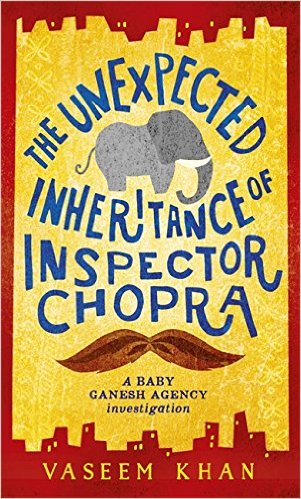
Vaseem Khan – author of the Baby Ganesh Detective Agency series


Baby Ganesh is a delight – but where did the inspiration for his eccentric partnership with Inspector Chopra spring from?

You could say this partnership was born on my first day in India, back in 1997 when I went out there to work as a management consultant. I was in a taxi and we stopped at a traffic junction. As I looked out into the passing passing traffic of honking rickshaws, honking trucks, bikes, people, cows, goats, and dogs I saw, lumbering through the chaos, an enormous grey Indian elephant. This surreal sight stuck with me and eventually became a part of the crime novel I wrote when I returned to England ten years later.

You’re a British author writing novels set in modern day Mumbai. Why there, and how would you describe your relationship with the city?

I lived in Mumbai for a decade, and for me it remains the most dazzling city on the subcontinent. The place is a non-stop assault on the senses. I’ve tried to encapsulate this in my books, to give readers an idea of what Mumbai looks like, feels like, sounds like, smells like, and even tastes like. My aim was always to take readers on this journey to the heart of modern India, a place that is undergoing immense change, with globalisation bringing money and sweeping cultural transformation. Yet at the same time it is a place beset by ancient problems such as poverty and caste prejudice. This dynamic between old and new gives me a unique canvas. As someone who loves crime fiction set in exotic locations I wanted to use this to give readers something different.

The Baby Ganesh series comes from the lighter end of the crime fiction spectrum – but you don’t shy away from showing us the poverty and deprivation that lives alongside Mumbai’s prosperity. Did that balance between tone and subject matter come naturally, or did you struggle initially to find the right voice?

I always set out to create a sort of 'gritty cosy crime'. Inspector Chopra is a serious man, and the crimes he tackles are serious crimes, murder, kidnapping, robbery. His elephant sidekick offers light relief, as you suggest, but I always intended for the books to showcase both the light and dark of modern India. This reflects my own experiences there. When I first went to Mumbai, every aspect of the city was exotic and different. However, once I’d spent some time there I began to see that there were aspects of this amazing place that required me to put aside my rose-tinted spectacles and take a closer look. My first trip to the Daravi slum for instance left me open-mouthed. Poverty is endemic, but what is more endemic is the acceptance of poverty, of poor sanitation, of very limited medical facilities, of terrible transport infrastructure, all the things we take for granted in the West. There is a massive gap between rich and poor, and although social change is taking place there are still ancient prejudices ingrained in people’s thinking. Chopra and I both worry about such things - in effect, his voice is my voice!

*****

From: First time writers: From draft to publication
Radhika Swarup, author of Where the River Parts


Hi Radhika. Nice to talk to you again, one year on from the Triskele Lit Fest. It must have been an interesting year for you, with all the attention given to the 70th anniversary of Partition. Has it led to any new discoveries about what happened back then?

Lovely to hear from you, Catriona. This year has been poignant, not just for the milestone it represents, but also for the memories it unearths. While things are getting more political - and more polarised - on both sides of the border I have written about, it is interesting that the same hand-wringing was followed by increased political machismo twenty years ago. Where the River Parts draws to a close 50 years after Partition, when both India and Pakistan embark on their nuclear programmes. This, the 70th anniversary of both Independence and Partition, is also serving as a forum for families to talk and share their individual histories. While Independence is, and should be the main story, the generation that lived through the Partition is now reaching the end of its life. It is essential these stories are handed down while there is still time.

Your protagonist, Asha, is very young at the start of the novel – feisty for the times, but by modern standards, very much constrained by rules and conventions. How did you find the right voice for her?

We are all subject to the constraints and prejudices of of the times we live in, and Asha was no exception. Her head is kept covered at the start of the novel, and she is expected to marry her parents' - and crucially, her father's - choice, but if you examine the path she leads, she has great agency. She survives a very tough journey into a new country and settles into a hostile household. She chooses not to be defined by her disappointments. She is a true survivor, able to make her way in whichever environment she finds herself in, and though she has her quirks, her impetuousness chief among them, it was a privilege to be able to inhabit her world.

Tell us about your writing routine.

My writing routine is largely defined by two variables. My children and my relationship with my Work in Progress. If I'm in the middle of writing a draft, I find it easiest to wake at 4am to write while the house is quiet. The children rise around 6, and as winter draws in, closer to 7, and we're all in a rush to finish off breakfast, homework, music practice, gather the football cards my eldest loves to trade, and deposit them both safely - and gratefully - to school. Then I write again from 9am to pick up time, and after they're in bed.

Are you now writing a second book, and how does that differ from tackling a first novel?


I'm working now on my second novel, and the main difference to writing my first is that I now know and am comfortable with my habits. I know to adhere to the schedule I've described above, but everything else - the uncertainty while you plot, the frenzy when you actually get down to the writing, and the visceral disdain for your work when you first read it back - remains the same. I think that's what keeps you going as a writer, and that's what keeps you striving to improve.

*****

From: Love and marriage in fiction: a road to happiness?
Radhika Kapur

You’ve written advertising copy and worked as a ghost writer as well as writing your own short stories. How does the writing process differ in these three media?

Well, in my work in advertising I write in a brand's voice. After a few years of doing that, I was bursting to write in my own. That's when I turned to short stories. Also, advertising is about influencing human behaviour, short stories are about human behaviour.

Of course, each medium requires a different skill set and also overlaps with and enriches the other. That's what I love about it. My work as a copywriter has taught me the power of strong, bold ideas and of editing - I usually have just one headline or thirty seconds to make my point. The more you chisel it, the sharper it gets. That's what you need to do in short stories too.

Short fiction lets me explore fleeting nuances of everyday life. It's a photograph of an emotion, a time, a moment. 


I read your short story, ‘The Nine-Headed Ravan,’ in the anthology Love Across a Broken Map last year. It’s a beautiful and ironic study of the nature of love. Where did the concept for that story come from?

From bits and pieces of my own life and my own relationships. As a young woman, I would try pinning down love, defining it and boxing it - but love is the annoyingly shaped object that won't fit into any gift box. The nine-headed Ravan actually exists - it was painted by my mother! As the story grew, the role of the painting as a metaphor also grew

I thought it would be interesting to explore a character who is anal about the truth and words. As a writer, I can be like that. I take words very seriously. Which is why my husband is always in trouble!


To echo the question being asked in the panel, what do writers gain and lose in writing about love?

The more honestly we talk about relationships and love, the more we all gain. There are so many manufactured, sugary-icing versions that sit inside our brains.

The only thing I lose is that I expose a very deep, private side of myself, while writing. But, that's ok. How is there to be any meaningful conversation otherwise?

*****

From: Dividing Lines Book Launch
Farrah Yusuf

I was very moved by your story ‘By Hand’ in Love Across a Broken Map. It encapsulated the loneliness of modern urban life. Where did the inspiration for that story come from?

Thank you, that is lovely to hear. I wanted to explore how we all connect - be that through a place, in person or remotely and the assumptions we often make from the little information we have. I decided to use the form of letters rather than email or texts because I rarely get handwritten notes anymore and when I do I always think they say so much more than just the words on the page. I decided to set the story in a flat in a city because I find it interesting that we can all be so close physically but mentally remote.


You’re a playwright as well as a short story writer. How does the writing process differ between the stage and the page? 

If I am writing a play I am always thinking about what the action is and what is happening in each sentence, as to even move a character from one side of a stage to another there needs to be a reason. In short stories on the other hand I can indulge in descriptions and move a character in both place and time with a single sentence. I enjoy both as they let me experiment with words in differing ways.

What can you tell us about the new anthology, Dividing Lines

 What strikes me most about it is the spectrum of ideas it explores on the same theme of borders, boundaries and belonging. Each story takes a unique take on the theme and the subtleties within it without straying too far from that central concept. Mine takes a broad interpretation as my story is about a missing father and the way his disappearance impacts on the other characters.

An all-day festival ticket costs £30. Workshops need to be booked separately.

For more information about the festival, for images or quotes or to interview any of the authors featuring at the festival please contact Farhana Shaikh at f.shaikh@dahliapublishing.co.uk or on 074321 29371

Festival box office: https://www.eventbrite.co.uk/e/the-asian-writer-festival-tickets-37684746090


Wednesday, 21 December 2016

Highlights from the Triskele Lit Fest

When the Triskele Books' one day Lit Fest came to a close in September, we knew that the conversations generated across the five panels were far too good not to share with a wider audience.

Thanks to sponsorship from Matador Books and sound engineering expertise from Live Box (who overcame some significant challenges in the form of noise intrusion from dance classes in the room above) we were able to record the panels and upload the videos to our YouTube channel.

Here are some of the highlights from the day, which we hope will tempt you to delve into the videos to watch the discussions in full.

Sci Fi and Fantasy

We kicked off the day with a lively discussion with Sci Fi and Fantasy authors Felicia Yap, CS Wilde, Jeff Norton, Eliza Green and Yen Ooi, chaired by Jack Wedgbury from Matador.

The panel showcased the vast range of modern Sci Fi and Fantasy. Felicia's upcoming Yesterday is a thriller about a murder being investigated in a world where most people only remember yesterday. CS Wilde's A Courtroom of Ashes is a fantasy about a lawyer in hell. Jeff Norton's MetaWars explores what happens when humans retreat from the real world into a digital one. Eliza Green's Becoming Human imagines humans competing for resources with another race on a distant planet, while Yen Ooi's Sun; Queens of Earth harnesses the powers of dreams to provide energy.

Between them, they reveal their inspiration and discuss how SFF liberates them to explore big themes from what it means to be human to the destruction of the Earth, but to view them through a personal perspective.

What do an oyster card, an iPod, a set of Bose headphones, a paintbrush and a passport reveal about their writing processes?


Romance

In the second panel of the day, Triskele's Liza Perrat talked to Romance writers Isabel Wolff, Charlie Maclean, Sareeta Domingo and Carol Cooper.

Isabel is an accidental novelist who began her fiction career when a newspaper column about the singles scene was turned into a novel. She has since written ten more novels.  Charlie Maclean's Unforgettable is a 'Sliding Doors' type story that explores the consequences of asking someone on a date ... or not. Sareeta Domingo's The Nearness of You, about a young woman falling in love with her best friend's boyfriend, also examines themes of bereavement and depression. Carol Cooper's multi-stranded narratives follow an array of couples at different stages in their lives.

They explore how far a Romance novel can play with the RWA's definition of "a narrative centred around two individuals falling in love and struggling to make their relationship work." They consider the role of sex in a romance novel - does it have a place in moving the plot forward and revealing character, or should the author keep the bedroom door closed? When men write Romance, does it get 'elevated' into a different category? What happens when you try writing in the dark?

And a pocket watch, a photograph, some music and a bottle of bathroom cleaner reveal surprising secrets about their writing process.

(With apologies for the poor quality of sound in the audience segments on this video)

Crime and Thrillers

Next, Ben Cameron of Cameron PR talked to Crime and Thriller authors Kate Hamer, Adam Croft and Chris Longmuir.

Kate Hamer's The Girl in the Red Coat is a dual narrative about a mother and her lost child. Adam Croft's Her Last Tomorrow is also centres round a missing child, but in this case the father receives a ransom note with an impossible demand. Chris Longmuir's Devil's Porridge is a historical crime novel based around the first policewomen in Scotland, guarding a munitions factory during WWI.

They contrast the challenges of the different types of stories they tell, reveal the horrible secret of what Devil's Porridge really was, explore the new concept of Grip Lit, and explain how a bottle of perfume, a literary award and the scan of one's unborn child continue to inspire their writing.


The empty seat at the end of the row belongs to Nigerian author Leye Adenle, who was prevented from getting to the Lit Fest on the day. Catriona Troth caught up with him a few weeks later and you can read her interview with him here

Historical Fiction

In the last genre based panel of the day, four very different authors discuss Historical fiction with fellow author Jane Davis.

Orna Ross's Her Secret Rose is a fictional account of the real life lovers WB Yeats and Maud Gonne. Radhika Swarup's Where the River Parts looks at the largest displacement of people in human history, following the Partition of India, through the eyes of a young Hindu woman. JD Smith's Overlord series takes us all the way back to 3rd Century Syria and the life of Zenobia, the warrior queen who nearly toppled the Roman Empire. Alison Morton's Roma Nova series is an alternative history in which the Roman Empire survived into the 20th Century.

The four authors reveal why the chose their particular stories to tell, the different challenges and responsibilities of writing history from the recent and distant pasts, how to create a voice appropriate for a different time period , and the discovery that surprised them most in the course of writing their books

And an index card, a bracelet, 'the only book I have ever defaced' and a photograph of a Roman gladius reveal secrets about their writing process.


Preserving the Unicorn - conversations with literary authors and their editors.

The last panel of the day was a discussion with literary authors and their editors, chaired by Triskele's Catriona Troth. Sunny Singh discusses her novel, Hotel Arcadia, and the fascinating role her Dutch translator played in honing the manuscript. Alex Pheby and his editor from Galley Beggar Press, Sam Jordison, discuss his novel, Playthings, the fictionalised story of Daniel Schreber, of one of Freud's most celebrated case studies. And Rohan Quine and his editor Dan Holloway take the lid off the process of editing Rohan's latest novel, Beasts of Electra Drive.

In this wide-ranging conversation, Sunny reveals inspirations ranging from Dante's Inferno to Martin Scorsese's Goodfellas. Alex  explains how his novel grew out of frustration with blinkered 20th C analysis of Scheber. Sam  describes how he absorbed the emotional impact of the book and imagined telling a reviewer, "I've got this book and it's going to destroy you," before deciding "of course we've got to publish it."  And Rohan describes his book  as a 'love bite to the world,'  while Dan calls it 'a beautiful spectacle compiled of horror.'


Part way through the conversation, Alex Pheby threw a provocation to the audience. "All forms of masculine activity are vile and pernicious and should be weeded out." Sadly, time ran out before the implications of this could be explored. After the event, though, Orna Ross came up with some great questions for Alex. We hope to get the chance to put those questions to him in the new year. If so, we will publish his responses in Words with Jam.

Wednesday, 3 February 2016

Et In Arcadia Ego

By Catriona Troth

credit: Walter White
The young Sunny Singh had a practical approach when she found no representation of herself in books. She rewrote them! So perhaps it is no surprise to learn that the adult Sunny Singh wrote her third novel, Hotel Arcadia, in part in ‘answer’ to Dante’s Inferno.

Last December, I spent an afternoon in conversation with Sunny Singh, author of Hotel Arcadia. In the course of two hours, we managed to take in Dante’s Inferno, Judeo-Christian theology, the teaching of creative writing, diversity politics, gender politics, and the highs and lows of social media. This is my attempt to distil that conversation down into a few thousand words!


ON THE INSPIRATIONS FOR HOTEL ARCADIA
Cover image of Hotel Arcadia

Hotel Arcadia is the story of a terrorist attack on a luxury hotel. The premise could be the outline for another Die Hard film, but Singh transforms it into something quite different. Instead of focusing on the battle between the terrorists and the soldiers, she homes in on two people who would be bit players in any Hollywood movie. Abhi, the hotel manager, trapped in the operations room, watching events unfold on the closed circuit television screens. And high up in the tower, Sam, a photojournalist spending the last night of her assignment in the hotel.

In my review, I described the book as a duet. But Singh herself has gone further and described it as a love story.


“Back in university I discovered Dante’s Inferno, and I always go back to it. I am fascinated by the story of Paolo and Francesca, the doomed lovers, condemned to circle eternally but never to reach each other. I always told my professor that I wanted to rewrite the story – because I wasn’t so sure that the idea of eternal longing without consummation was such a bad thing.

“Even the architecture of the hotel is based on the nine circles of hell. Abhi’s lover is in the second circle, with Paolo and Francesca, and below Limbo, the preserve of unbaptised children and the virtuous pagans. The lowest level –where the great betrayers are (Judas / Brutus-Cassius / Lucifer) –is where Abhi is found.

“It’s a strange choice, to place him there. I do realise that. For me, Abhi is the moral core of the book, and yet every choice he makes in his life is a betrayal, often of himself. After all, it is possible to argue [as the Gnostics did] that Judas’s act was not a betrayal, but an act of love, the ultimate sacrifice, knowing he will be condemned to hell for what he has done, but that it is necessary to enable everything that follows.”

The name of the hotel, and thus the title of the book, is deliberately chosen. There are many hotels called Paradiso. But Arcadia represents an earlier, pre-Christian idea of an earthly paradise – “Claiming space,” as Singh says, “for two people who wouldn’t be allowed into Paradise.

But there are echoes, too, of the expression, “
Et In Arcadio Ego”: even in Arcadia I am there – ‘I’ being Death. The earthly paradise of this luxury hotel is under attack. More than that, Singh adds:

“Genocides are planned in very nice places like that luxury hotel. These places are not safe.”

Book Trailer for Hotel Arcadia

My immediate association with Hotel Arcadia was the terrorist attack on the Taj Mahal in Bombay. But in fact, the inciting incident for Singh goes back much further.

“I was travelling in Peru in 1994 or 95, when the Shining Path planted a bomb in the small hotel where I was staying. The only people killed were the receptionist and bellboy – the very people the Shining Path were supposedly fighting to protect. I was outraged by that. But it was something I needed to park and process. I didn’t have the ability to write about it until at least 2002.

“You know, as members of any society we hand over a monopoly on violence to the state – whether it’s to go to war, or to carry out judicial killings. So it shakes us when an individual takes that power, even if we know that the state is unjust. It seems better for the state to kill than some random person to do so.

“I would never qualify myself as a pacifist. But I have huge concerns about how we perceive violence and the extent to which our reactions are conditioned by who practises it and who is victimised, rather than the act of violence itself. This is why we can accept narratives of ‘the good war,’ ‘the just war’. Our boys are noble. Theirs are evil.

“We have a hierarchy, too, of victims that we sympathise with. Women are valued as victims if they are young and pretty, or if they are mothers of young children. We rarely see women as the ‘great brain’ or the ‘heroic fighter.’ Male heroes are always good husbands and fathers. There is little space for queer heroes.”

ON THEOLOGY AND WESTERN THOUGHT

Singh often challenges – subtly in the book but head-on in conversation - elements of Christian theology that someone from the West might take for granted, or would not even realise are underpinning our ideas.

“It may seem a strange thing for an Indian, non Christian woman. But I grew up attending Catholic schools – so I have a deeply embedded Christian education. There are so many things I can intellectually understand but don’t culturally get. The idea of not being able to be saved – or that the intention of the act is not taken into account - is alien.

“Europe has this idea that its intellectual class is now completely secular. ‘Those crazy people over there follow religion and we don’t.’ So we don’t question the extent to which that long Christian tradition impacts us. As John Gray pointed out [Heresies: Against Progress and Other Illusions 2004], even the idea of progress as linear is essentially a religious concept! American exceptionalism has grown out of the Calvinist idea of predestination, of a favoured people. Success becomes a sign of your virtue.

“Just because the language has been secularised, it does not mean those ideas are not still there. They impact the way we deal with the world, the way we deal with politics. And we ignore that at our peril.”

ON LOSING A NOTEBOOK AND GAINING A NOVEL

Hotel Arcadia is a story that might never have been written. Before she even began writing it, Singh lost a crucial notebook.

“That was hilarious,” she says (with the gloss of hindsight.) “I started working on the novel as I was trying to finish my PhD. I was taking copious notes and I had gotten so lost in them that I couldn’t write. I had everything. I had philosophy. I had architectural plans. It was comforting but also overwhelming.

“Then one night I lost it on the Tube at Earl’s Court. The bottom of my stomach fell away. I was hyperventilating, completely devastated for about two hours. Then I went to sleep. And when I woke up, the book just took off in a mad rush. I wrote the first draft of the novel in about four and a half weeks, while I was still teaching. I had to tell my class, ‘If I’m not making sense, stop me'.

“I think a lot of it had to do with getting locked into a conceptual space. I bring a lot of philosophical, theoretical ideas to my work, and at some point I have to put all that on the back burner and just tell the story. I think because of the way it happened, I managed to bring in all my key ideas, but they were delivered with a light hand, instead of being hammered home. It was a very strange process and I wouldn’t recommend it to anyone. But it worked.

“There is always a morning. And things look different in the morning.”

ON TRANSLATORS AS EDITORS

Another unusual aspect to the development of Hotel Arcadia was the role of Singh’s Dutch translator in the editing process.

“So many publishing houses don’t have the same editing role as they did thirty years ago. Most books don’t receive that close look from someone with authority.

“In the case of Hotel Arcadia, the Dutch decided to bring out a translation at the same time as the English edition. Dutch is a more restrictive language than English (Most languages, I find, are more restrictive than English, which is why I write in English.)

“I had a very diligent translator, who was sending me long lists of notes, picking up issues like ‘if it’s three hours later, is it still dark?’. She came from a different story-telling tradition, and she needed clear answers on time and place. An English editor, I think, would have let it pass. Willing suspension of disbelief would have carried us through.

“That whole process changed the book quite drastically, made it far clearer and tighter.”


ON TEACHING CREATIVE WRITING

As well as being a novelist, Sunny Singh teaches creative writing at the London Metropolitan University, to a very diverse student group – and she has strong ideas about how appropriate the classic creative writing curriculum is for such students.

“Creative writing courses are based on the idea of ‘finding your voice’. But if you have been told over and over again, by books and by media, that your stories aren’t important, your history isn’t important, and ‘hey, the Empire was great, what are you complaining about?’ – how do you even begin to find your voice?

“I’ve had a global mix of students in my class sometimes realising, ‘we always write stories with white people in them (and not ourselves).’ So we spend a lot of time working on gender and race.

“In that situation, there is an automatic tendency to look towards American authors, which ignores Black British writers and Commonwealth writers. But that’s where most of my students have their roots. They have certain overlaps with the Americans, but also different backgrounds and histories and senses of self.

“Focusing on American writers allows white British people to wash their hands of their own history. Remove Caribbean writing, say, and you are wiping out a legacy of slavery and imperialism and the Windrush generation.

“Lloyd Shepherd [author of The English Monster], is the only explicitly post-colonial white British writer I know, who writes a critique of the self-glorified narrative that ‘Britain abolished slavery.’”

ON PRIVILEGE

I ask Singh about the strong pressure, coming especially out of the US, to examine ‘white privilege.’

“There are layers and layers of privilege. Race is only one axis. There are multiple others: gender, sexuality, geopolitical. If you are a northern, white working class man, you have a larger set of possible texts to relate to, but not by much. We need to understand both own privilege and our lack of it.

“We do an exercise in my class based on Peggy Macintosh’s ‘Invisible Knapsack’. What that reveals is, yes, we’re all British, we’re all in this classroom, but we are not all equal. Unless you can see that, you are not going to be able to write it. But the moment you break it down, you create a space where it’s okay to tell the story.

“Funny how it’s often the straight white male who mocks the idea of safe spaces – because they’ve never needed one.

“In the American debate, the biggest elephant in the room is how much geopolitical power they have. How much their views are being exported and how much they are shutting down others, like African and Caribbean voices, when they are talking about race. That’s also privilege talking.”

ON HEROIC WRITERS

On her blog recently, Singh quoted Tony Morrison: “We don't need any more writers as solitary heroes. We need a heroic writer's movement: assertive, militant, pugnacious.” I asked her what that meant to her.

She cites a series to graduates of her BA programme, including Matilda Ibini (playwright who won the 2015 Alfred Fagon Audience Award for her play Muscavado, set in a sugar plantation in Barbados in 1808); Warson Shire, whose refugee poem, 'Home' was quoted nightly by Benedict Cumberbatch at the end of his performance of Hamlet; Roxanna Donald who wrote a powerful play, Spike, on sexual consent; the children’s writer Lil Chase.

“We don’t have to agree with each other. We don’t have to be friends. But we are all writing consciously and ethically.”

ON ERASURE

Singh has written about her own feeling of ‘erasure’ when she went from India to the US – which put me in mind of Chimamanda Ngozi Adichie’s well known TED talk, ‘The Danger of the Single Story,’ in which she talks of not realising, as a child, that stories didn’t have to be about white people.

“I grew up in India. I read books in Hindi. So unlike Adichie, the idea that women like me didn’t appear in stories never occurred to me. When I started reading books in English as a child, it would annoy me if there were no people like me in them. So I would rewrite them.

“When I was 11, we moved to Pakistan. That was my first exposure to being a ‘minority’. The idea that one part of your identity – your religion, or your nationality or your colour – could become the most important part was a real shock. But at least we shared a similar language. We watched the same Bollywood films. We looked similar. All those things helped negotiate being part of a non-visible minority.

“I think what the US did was to show me that there was a completely different point of identity, where a visible minority can be deliberately erased. Where we inhabit a liminal space. That sticks out to me as a real culture shock.

“At the same time, I am aware of certain literary tropes that diaspora writers have. That sense of ‘over there is bad; over here is good.’ Like the ending of Monica Ali’s Brick Lane – ‘you can be anything you want.’ Really? As a brown woman in Britain? Are you bullshitting me?

“I can’t write about India as Adichie does about Nigeria or Hosseini does about Afghanistan, because in some ways I feel as much a foreigner in India as I do here. But I can write about in between spaces very well!”

ON PROMOTING DIVERSITY

Before the backlash against the ‘lilywhite’ Oscars, came the backlash against the all-white list of authors for World Book Night 2016. How did Singh feel about the Twitter campaigns (first #diverseauthorday and #diversedecember, then #readdiverse2016) aimed at promoting more diverse authors? Was there a risk that these were just another case of ‘hashtag tokenism’?

“There seems to be no winning card. If you speak up, then it’s hashtag tokenism. If you don’t speak up, then you can be ignored.

“The BAME market is worth £3bn a year, and it’s a market that’s not being catered for. So of course BAME readers are going to go online. Of course they are going to buy self-published authors. Because you are not tapping that market at all. You are not even touching them.

“Prize committees say publishers aren’t putting writers of colour forward. Publishers blame the agents. Agents say authors aren’t submitting to them. I look at my agent, who has an extraordinary list, but works twice as hard as anyone else trying to place them. So don’t tell me that the authors aren’t there. In the end it comes down to ‘you are not telling the stories we want to hear.' The ones that will allow us to re-inscribe our stereotypes – Indian women who have arranged marriages; African women who end up raped or killed and so on.

“If I refuse to write those narratives, I’m in trouble. If I write those novels, I am still in trouble, because there is still only going to be one ‘Indian’ book per year, or one ‘Asian woman in Britain’ book per year per publisher. If I don’t critique, I’m in trouble, because I’m not speaking up and it’s my fault. If I critique, then I’m angry and I’m not playing ball, and it’s still my fault. So my logic is it’s too bad. I have readers. I am not in the self-publishing world, but I am doing most of the publicity for my book.

“My first two books were not published in Britain at all. They were either ‘too Indian’ or ‘not Indian enough,’ depending who you talked to. They were published in English in other countries. They were published in multiple other languages (French/Italian/Spanish). But they have never been published in Britain.

“Why can’t we talk about Hotel Arcadia as a terrorism book? Why does the fact that I am a woman change how it is received – not by the reader but by literary festivals. Why am I not being asked to talk about politics? Why must I talk about women’s issues, or diversity issues? Why can’t I talk about literature and terrorism and politics and all the things the book is about?

“It comes back to institutions making deliberate choices. I don’t think it is inappropriate to ask big companies to pay their staff a decent wage. I don’t think it is inappropriate to expect them to hire, deliberately, a wider range of people. But they choose not to do it.

“The publishing industry thinks they can have a little conference every now and again, and we’ll have the same people saying the same things, and then we’ll have done our job and we can park it and go back to doing what we always do. So at least #DiverseDecember, and so on, is getting people talking about the books and the writers. A bit of rattling the cage isn’t going to hurt.”

ON SOCIAL MEDIA

I first encountered Singh on Twitter, where she has a strong presence. Does that mean she sees social media as something positive, at least in part?

“I see it mostly as positive, especially Twitter. I have made so many friends there, both online and in real life. I have yet to meet anyone from Twitter who isn’t exactly how they seemed online. It’s so immediate; it lends itself to a sort of intimacy. You know someone’s politics – but you also know if they are a dog person or a cat person.

“For example, during the time in Tahrir Square, I followed one woman who was very vocal, very passionate, very political. Around two in the morning, I had insomnia. I was on Twitter. There was a lot going on, so they were constantly updating. She suddenly said, ‘I do realise this sounds frivolous, but I need to get my eyebrows done!’

“We have had every last breath of men over the centuries. But we haven’t heard the voice of women like this before. Women talking about themselves. The quotidian. It hasn’t been recorded before. The image is always filtered, and Twitter takes those filters off.

“On the other hand, as a writer, for the first time, I have the ability of the gatekeepers and reach out directly to the reader. And that is quite special. I had one Twitter follower who invited me to his book club – which meant Skype chatting between Seattle and London. The idea that you can do that is extraordinary!

“So yes, I’m a bit of a Twitter evangelist.”

She did, however, have an interesting experience once with changing her avatar on Twitter.

“One of the exercises I get my students to do is to have first a male character and then a female
character walk into a crowded pub, to describe their body language as they walk to the bar and order a drink.

“You always assume that Twitter and 'real life' will be different. But that is not the case. As a woman on Twitter, I get a certain amount of drive-by sniping – the equivalent of cat calls. Men who insult you or mansplain or tell you to shut up or say something quite sexual. No different to walking down the street. To me that is a structural issue. It’s about keeping women in their place, about saying public spaces are for men.

“Then I happened to change my avatar. I had been diving in Egypt, and there was a photo I really like that I decided to use. And because I had a mask on, you could no longer see whether I was a man or a woman. (Underwater is apparently not a female space – don’t ask me!) And the drive-by sniping stopped. No mansplaining. No ‘shut up you don’t know what you are talking about.’ Male journalists that I had followed for a long time started reaching out to me. Suddenly my opinions had weight, because I was underwater with a mask on!

“To me, that was quite telling. Gender still matters.”


Sunny Singh is an author and journalist. She also teaches creative writing at London Metropolitan University. She was born in India, and has lived in Pakistan, Spain, South Africa, Latin America and the US.

Friday, 20 November 2015

Large Fears

Myles Johnson, author of the self-published children's book, Large Fears - a book for queer black boys and anyone else who's ever been scared - talks to Catriona Troth about phobias, dreams and intersectionality


Hi, Myles. Could you start by telling our readers about Large Fears?

Large Fears is a children's book I wrote centered around Jeremiah Nebula, the black boy that loves pink. It began as a kind of reconciliation with phobias and traumas I acquired while being a young black queer boy in the world. I wanted to create something that turned the ugly things that I faced as a child into something beautiful and inspiring.

This is a very personal book for you. Tell us something about what it means to you.

To sort of expand on it, it really is me having a conversation with my childhood and with every child that feels ostracized. Since creating this book and coinciding projects, I've felt like the dark things that I have gone through in my childhood and early adulthood have been for a purpose now that I am able to see how many people resonate with the story.

You also run workshops for children based around the book. Can you tell us a bit more about that?

The Large Fears Workshop is a workshop we conceptualized around helping children, and adults, conquer and discuss their fears. We used art projects and literature to help kids describe their fears, used concepts of community to help discuss ways to conquer their fears and ultimately reach their dreams. The idea is to help kids know through honesty, art, community, and belief there is not a fear large enough to stop them from their dream.
Reading from Large Fears at a workshop
©Devin Johnson / http://www.overdosedondope.com/photography/

The book's hero, Jeremiah Nebula, is described as a 'queer black boy.' Can you steer me, as a cis/het woman, through the rights and wrongs of the use of the word 'queer'?

Queer is a reclaimed word by the LGBTQ community that essentially ecompasses sexualities and gender expressions that deviate from the normative cishet expectation. The reason I used the term for Jeremiah Nebula is because I wanted to avoid sexualizing a child. Whereas "gay" and "homosexual" bring up ideas of romance and sex, queer is describing gender expression.

How did your partnership with the illustrator, Kendrick Daye, come about? At what stage did he come into the project? Is he involved in the workshops too?

Yes, Kendrick Daye isn't your regular illustrator that draws for the book and disappears. He's a true partner in this whole experience. He was there from the birth of the project until this very day, helping me grow the book, the products, and the workshop. I could never imagine being on this journey without him. Besides everything else, Kendrick is my best friend. He's my big brother. In a lot of way, he's the love of my life. He talks me off ledges and affirms my identity. He's a huge reason this book exists because his friendship helped me realize there was love and acceptance outside your family in the outside world.

It's a brave choice to self-publish any book - more so, I think, for a children's author. How much was it a positive choice for you, and how much a response to frustration with the trade publishing world?

It didn't feel very brave. I never saw a book like what I was writing on shelves. Beyond just the fact that he is black and queer, but the fact that text is lengthier for a children's book and the art is a kind of a homage to street culture and pop art. It was a risky creation in so many ways, but every time I got scared, I reminded myself that I created something about conquering your large fears, so succumbing to my large fears in any stage of this book would make me feel like an imposter. Now, that the book has genuine fans, those people make it much easier to be brave and keep pushing even through the difficult elements of getting this book out there. The fact that even one child has read this book has made anything I could complain about, worth it.

You crowd-funded the project through Kickstarter. That was clearly a successful move. What do you think were the keys to that success?

The key to success with getting money for any creative project, I believe, is creating something people want to see. It just so happened that what I desperately wanted to create was something that people wanted to see and were willing to skip a coffee break for. I know how hard people work for their money, so for someone to give it to me and my dream is the most humbling experience of my life, honestly. And I think everything I am doing when it comes to this book and beyond is so that person that gave me five dollars feels like it was money well spent, or better yet, money well invested.

Apart from the workshops, which we've already discussed, how have you approached marketing the book since it was published? What have been the positives and negatives of going it alone, with no publisher to either back or constrain you?

We've luckily had diverse press coverage, so that is definitely an element of marketing. From Saint Heron and Afropunk to NPR and NBC to BuzzFeed and Huffington Post, this book resonates with a lot of corners of culture which I think gives this book a quality of importance and "coolness" that you can't storyboard or predict, the public does that.

Aside from that, we've made sure the Large Fears world and Jeremiah Nebula are tangible on social media. We wanted it to feel less like just a product, and more of a world and your ticket to this world was a story. We created shirts that read "Black Boys Love Pink" accompanied with a stylized photoshoot that is an extension of the Large Fears brand, but it has had the ability to have a life of its own as a movement and a more adult "sub-brand", if you will. Also, we created short holiday-themed stories and memes with Jeremiah Nebula's mom entitled, "Mama Nebula Says". 

We made these things as a thank you to the people who support us, love Large Fears, and want to engage with Jeremiah Nebula. We also created these things as a marketing technique to make it so the Large Fears world feels like it living, evolving, and ready to be engaged with. 

The biggest obstacle about not having a publisher is being everything at once. We're not just the creators, we're the salespeople, the PR, the marketing department, the social media strategist, and accountants.

You have a separate Twitter feed for Jeremiah Nebula (@largefears). Is that aimed specifically at your young audience? Do they interact with you on there?

It is aimed at the younger audience, as well as people that prefer to just interact with the Large Fears and Jeremiah Nebula, and not necessarily myself and Kendrick. And yes, we get the cutest mentions and pictures from the young ones and adults!

This is a book for children, but it is hard not to see it in a larger context. Marlon James's recent Man Booker winner, A Brief History of Seven Killings, attacks the intolerance and hypocrisy of Jamaican society towards gay men. And there are grave concerns regarding the safety of gay men in many African countries. Do you think there are particular challenges to being both gay and black, even in outwardly more tolerant societies?

The intersection of being queer and black is a difficult one. You're carrying two oppressions and that is difficult. And yes, economically, politically, and socially, I can be oppressed by not only the cishet community, but the white community. That is a lot to put up with, but amazingly, I've been carrying the oppression for so long that I've come numb to how heavy it is, so even when asked about it like now, it's hard for me to articulate my strife because I've become so accustomed to ignoring my pain. But yes, even in progressive cultures, this intersection oppresses me.

What is your greatest hope for the book and for the audience it addresses?

My greatest hope for the audience it addresses is for a true liberation of possibility and wonder to happen inside of them. My greatest hope for this book is that it surpasses any hope that my tiny brain could ever conjure up.

Finally, I believe the book is not currently available in Europe. Any plans to launch it internationally?

We're working with a fantastic literary agent, so hopefully upon landing a publishing deal, we'll be have to offer this book internationally.

Thank you, Myles! We look forward to that. In the meantime, for those readers in the US, here's where to buy the book and those cool t-shirts:  http://largefears.com/store/