Wednesday, 27 May 2015

Margaery Tyrell with No Clothes On. (…and other adolescent dreams)

Procrastinating with Perry Iles

The other day I made my daughter cry. Don’t get me wrong, I didn’t punch her in the mouth or kick her downstairs or delete her Facebook account or anything truly cruel and unusual. I did it with words, because words are what I’m best at. It was the day after the British general election, and I put on my best Private Frazer voice and said: “We’re doomed. Doomed, I say…” I then suggested that poor people would come and eat our household pets before the decade was out, and then I found Bowie’s Five Years on YouTube and played it quite loud. When the song ended the silence was the sort you only get in family homes, when the atmosphere is thick enough to be diced with a knife and deep-fried with a side of fries. My daughter sat with her face covered in tears, before asking me why I had to be so cynical and miserable about absolutely everything. Then, pausing only to kiss each of the dogs in turn and cuddle the cat (who protested loudly because he’s a miserable old bugger like me), she did that flounce-up-the-stairs-and-slam-the-bedroom-door thing that all women are good at until they get to the age where they have to use a Stannah stair-lift to flounce up the stairs in. 

So I sat there for a while, feeling the waves of displeasure emanating from my sweet wife as I pondered when and why and how I’d got so cynical, world weary and misogynistic. I don’t think I’m a racist, a sexist or a homophobe. But maybe I’m all three because I always say I hate people in equal measure, that I’m an equal-opportunity cynic, taking the piss out of all and sundry while around me the world goes to hell in a handcart. When my wife eventually spoke, she said just this: “Don’t you ever get tired?” And, like always, she was right. I am tired. I sleep at night and then after the kid’s gone to school I do some work and then sleep in the afternoon. Sometimes I’ll nod off in the evenings too, all covered in dogs at the comfy end of the sofa. I am old, I tell myself; I have earned my rest. I am sixty, and well into what Frank Sinatra would call the autumn of my years. If I live to be 80, I’m going to have a fag, that’s another thing I tell myself, but sometimes I look at my dogs and wonder if they’ll outlive me. So why am I such a grumpy old bastard? Why do I slip so easily into that Clarkson-y category? I’m white, middle class, I’m not broke and I don’t have a mindless job, or worse still a stressful one. I don’t have to punch anyone when they won’t get me hot meal or anything. So I thought about my upset daughter and my miffed wife, and I came to some kind of epiphany. The world is pretty miserable without me adding to it. I’ve said as much when talking about my writing. Authors of fiction are just lying for fun and profit, I said, so why tell horrible lies when you can tell fairy tales? Not that I’m some sort of peace-loving, vegetablist hippie bastard, but… see? There I go again. A friend once told me that if I live an attitude, that attitude will eventually come to live in me, and that I will subsume my will to it. So I’m practising being nice. Not that it will earn me anything or make me better off, but seeing my daughter do anything but cry is probably a step in the right direction, because I’m quite fond of her. So anyway, what I did was to pop out and get my wife something for our twentieth wedding anniversary, which was in May. I tore up the card in which I’d written “you complete me—plus you still have magnificent tits” and wrote her another one in which I simply told her I loved her. Because I do. Sue me…

So what’s it like, this whole being nice business? It’s odd, frankly, and rather unfamiliar. I have started to garden. There’s a verb. To garden. I garden, you garden, he/she/it gardens. We are gardeners. This is the gardener’s Ferrari, and here is Astrid and her twin sister Helga, who are surgically enhanced Swedish contortionists who live with the gardener in his Scottish castle. See? From a basic concept to one of those bad noun-turned-verb-expressions straight back to cynicism, world-weariness and a dig at the nearest minority group. Depressing, isn’t it? But in my head gardening goes with rhubarb and caravans and a nice sensible Nissan Insipid and Caribbean cruises with Daily Mail readers for company and Murder She Wrote and all things vapid and predictable. So I set all of these terrible thoughts aside and simply did the gardening. I planted cherry trees outside my front door, filled some hanging baskets with fuchsias without using them as swear-words. I planted a clematis out by the back fence without once referring to it as a clitoris and I potted peonies without making any obvious puns. At this point my wife came out and cuffed me round the back of the head and re-planted all my flowers randomly. “You do the words, I’ll do the art,” she said. I’d been putting them in colour order, laying them out so each bed would look the same. They looked like gay Nazis at a Nuremburg Rally. I pondered spelling out a very bad word in the front garden in geraniums, but restrained myself.

Because I’m nice now. And I’m not making anyone cry and people like me more. I have returned to the Age of Innocence.

So, in a roundabout way, this brings me to the subject of young adult literature. Because I was young once, and although I was extremely badly behaved as a child (words like Oppositional Defiance Disorder and ADHD would be used now, I’m certain), I was still at some point or other a dewy-eyed optimist, the sort of fifteen-year old who wanted to go and live in Middle Earth and, you know, grow stuff, man. But this optimism guided my reading, especially in the early days, when the simple story arc of putting a good person in a bad situation and seeing them cope with it and emerge an even better person still held sway in my teeny-tiny little brain. But there were vital differences. As a schoolboy, there was a well-defined line between what I thought was good YA literature and what the school wanted me to read. If YA literature is described (as it is in that fountain of all knowledge, Wikipedia) as reading matter for twelve to eighteen year olds, then I guess I went from Narnia through Middle Earth to Gormenghast, stopping on the way for a bit of satire (Heller and Vonnegut), some science fiction (Edmund Cooper and Robert A Heinlein), and the usual revolutionary claptrap (Abbie Hoffmann, Jerry Rubin, Oz and IT.) Plus of course, YA literature for boys of a certain age (Between puberty and regular shags, basically) consisted of sneaking off to the bathroom with my father’s copy of the Carpetbaggers, which after a certain amount of re-reading would, if held loosely in the left hand, just fall open at the dirty bits while your right hand beat out adolescent rhythms of its own. Nowadays you don’t have to read, you can just nip off to the toilet with your smartphone and chafe the snake over a picture of Miley Cyrus or Harry Styles or whoever. Which is another great leap forward for the youth of today. When I was a lad (nearly 50 years ago now) all you could get was topless photos of Barbara Windsor or National Geographic articles on tribal dancing (why were nude ethnic minorities OK? Was it a racist thing? I was grateful enough for it in my time, mind…) Anyway, anything beyond the odd nipple was unknown territory, and as far as dirty bits in books were concerned, unless someone told you what page they were on you’d have to read the whole damn book. I developed Popeye’s forearm to My Life and Loves by Frank Harris, and I vowed in my innocence that when I grew up I was going to be a male prostitute because women would come and pay me to shag them. This hasn’t happened yet, and hopes are fading fast as I enter my sixties and my waistline expands further and I grow hair everywhere except on my head. But nowadays most adolescent boys are familiar with gynaecology and the many and varied approaches to reproductive activity without having to read a single word. What the Victorians referred to as “the Venereal Act” and Orwell called “our duty to the party” is now a commonplace from of online entertainment.

So what do kids read now? Rowling, Pratchett, Meyer, What’s-her-name off of the Hunger Games? JRR Tolkien has become George RR Martin. Which is a good thing too. A few years ago the BBC had a poll to reveal the best book in the English language, and Lord of the Rings won it. People of a certain age (usually those who smoked a lot of dope and called their firstborn Pippin Galadriel Moonchild) had looked back on their youth with starry eyed optimism and voted for a book that reflected the best time of their lives, rather than a book that was actually any good. Emboldened by the poll’s result, I went back and started re-reading LOTR for the first time in forty-odd years. God it was dull. Beautifully imagined, but turgid as a Victorian novel. It was like wading through treacle, almost as bad as reading Dickens. And as for poetry, Tolkien was unbelievably, toe-curling-embarrassingly bad at it. Go watch the films. They’re loads better. And go read Game of Thrones, it’s got swearing, proper violence and gratuitous breasts in it. And nobody’s going to think of it in any way other than what it is—a rip-roaring adventure yarn for boys who want to be Jon Snow (and are content to know nothing) but look far more like Samwell Tarly. I used to look like Samwell Tarly myself, only gingerer. I was bullied a lot and had no girlfriends and spent my weekends wanking and pulling the wings off flies. Just like Aragorn, son of Arathorn, King of Middle Earth and Thane of Cawdor or whatever the fuck he was. I’m sure Jon Snow is just the Aragorn de nos jours, but he seems a bit more three-dimensional, a bit more thought-out, and I bet he didn’t spend his adolescence thinking about Margaery Tyrell with no clothes on.

But now that I’m old and spend my dotage thinking about Margaery Tyrell with no clothes on, what memories do I have of the books I used to read? Not the ones I pretended to read when I was eighteen and carried Herman Hesse’s Siddhartha around in my pocket because I was a pretentious cunt, I mean the ones I really read? The ones I remember are mostly adult novels—Catch-22, The Magus and Lord of the Flies spring to mind, but I remember the eternal dichotomy between books teachers told me to read and the books I actually wanted to read. For years I was convinced Shakespeare was just a boring old fart, and it took me decades to realise that he made our language sit up and dance in a way no other author ever has since (although Cormac McCarthy comes pretty damn close). My tip for the best ever YA novel? Forty years ago I’d have said Alan Garner’s Red Shift, now I’d say David Mitchell’s Black Swan Green. The latter is a book they should force anyone contemplating a career in either teaching or parenthood to read at gunpoint. It is a brilliantly told coming-of-adolescence novel in thirteen chapters, set in 1982 and seen through the eyes of the first person protagonist, Jason Taylor, as he moves from his thirteenth birthday to his fourteenth. The book contains, as they say on the television, scenes of a sexual nature and offensive language, so I can’t see it hitting the school curriculum any time soon, but if the purpose of YA literature is to sum up how it feels to be a YA, there is nothing better than this. Not Tom Sawyer, not To Kill a Mockingbird, the Hunger Games or anything Pottery, Black Swan Green is the one. A bucolic, West Country Cider with Attitude of a book, something that outdoes Laurie Lee, which is a hard thing to do.

So, another two thousand words of opinionated ranting, sexual references and occasional swearing. I guess that’s in line with most adolescent attitudes. As for me, I’m 18 going on 61. Inside my wrinkly balding head there’s an eighteen year old wondering what the fuck happened. As David Mitchell said, if you look in an old man’s eyes, sometimes you’ll see a boy staring back and wondering how it all came to this. That boy gained his early experience vicariously, from reading. Writers have a responsibility to make that entertaining, literate, interesting—and above all, fun.

Snapshots from... Shenzen


In our regular series, international writers share some snapshots from their part of the world.
This issue, Carl Plummer offers his perspective on Shenzen in the Guangdong province of China.


By JJ Marsh


What’s so great about China?

Chinese people ask me this, usually expecting something about the history, scenery and food. Yes, the scenery is fantastic in places like Guilin, but you can spend half a day driving through concrete suburbs before you actually see some green, or even a clean river. My favourite place was Guangzhou, where I lived in a small village just off a main road. These villages are cramped, grubby, bustling and noisy – full of ordinary people searching for or making their fortune. They are more Chinese than the main city streets you find in large cities. Go to any large city and you could be in London, New York or Paris; just the same shops, same styles – something I’ve heard tell about High Streets in the UK these days.


Tell us a bit about the cultural life of the place.

The Chinese invented, are masters of fast food – steamed, boiled, fried, in bags, on sticks, in pots, sending smells wafting up the sides of tower blocks. Food is everywhere, with its packaging discarded like autumn leaves along every thoroughfare. The younger Chinese are a little more careful with litter, but the older ones drop anything without a second thought. Of course the food is wonderful, but I was pleased the other day to find a bottle of HP sauce, and Cumberland sausages in an international supermarket. Food from home can be a rare treat, and best kept as a rare treat. Wonderful as Chinese food may be, McDonald’s and KFC are everywhere, packed with grandparents shovelling French Fries into the mouths of little emperors. You think there’s a problem with obesity in the UK, well, it’s starting in China – in the richer areas – and such places are seen as exotic, perhaps in the way we welcomed the first Chinese restaurant in my old stamping ground of Salisbury in the 70s.

History is strange. Much of it was systematically removed by the Communist Party during the 50s and 60s. Zhou Enlai did manage to stop Mao from destroying the Forbidden Palace. The Great Wall is best seen from high up as you fly into Beijing from the north. I visited the Terracotta Warriors many times when I lived up in Xi’an. Looking at rows of soldiers is not very exciting after a few visits, but I am always fascinated in the mass-production techniques used; a production line that would have made Henry Ford green around the gills.

What’s hot? What are people reading? 

Finding reading material is not very easy in China if you are looking for the latest western novel. There are giant bookshops in the larger cities where you can find all the classics, and a good selection of biographies and history books. I have my favourite reading – often going through my tatty copies of Chandler or Wodehouse. My students were a little disappointed when I read them some Sherlock Homes; they were expecting Mr Benedict Cumberbatch and his chums – he is hot stuff here with the girls; they tell me it’s to do with his nose. Long noses are seen as beautiful here.

Who are the best known local writers?

I’m reading Mo Yan’s Red Sorghum at the moment: gruesome but gripping. The Howard Goldblatt translation is excellent. I also keep a copy of selected Chinese poetry in my briefcase; Poetry and Prose of the Han, Wei and Six Dynasties (Panda Books). Sagas are popular, great family tales covering a century or so. Also popular amongst readers of romance is Yan Ge Ling, with stories such as ‘White Snake’, ‘The Thirteen Women of Nanjing’ and ‘The Criminal Ly Yanshu’ becoming hits on the silver screen and the small screen.

What are you writing?

CC: https://www.flickr.com/photos/carloszgz/
I spent ten years writing detective/thrillers, even setting one in Libya and another in China. I had the usual lorry-load of rejections from agents, until a few years ago I had a two-page response from a reputable agent who had read my work carefully. His remarks were encouraging and honest, telling me the writing style was good, the stories good, but nobody will buy them: they won’t sell.
I decided to change tack. Having had a restorative read of Jeeves and Wooster, I wondered; what would have happened to Bertie Wooster if he’d lost his little all, landed on his uppers? And what if Jeeves was more sinister, perhaps even a traitor? The Pelham Hardimann comic adventures began. And, like any writer worth his salt, I decided on a pen-name – an anagram: Robert E. Towsie.

Words of advice for the China-curious?

Do not come to China to find yourself. I have met many a lao wai who has come here to do that. Many of them end up spending all their evenings sitting in ‘foreign-style’ bars drinking Budweiser or fake Johnnie Walker, griping about life with other unhappy foreigners. China, as full up of humanity as it is, can be a lonely place if you have nothing else in your life except work. There are a few Writers’ groups, sports teams, and rambling associations you can get involved in. When I am not writing I get on my bike and travel the 50km Greenway, which wiggles its way through the hills around Shenzhen – carless, with small farmsteads scattered about, free-range chickens and little hamlets of beehives where you can get fresh eggs and fresh honey.

You need something to do outside of work. You also meet a better class of person in these little hamlets – people untainted by the ‘screw the tourist’ mentality. And you don’t need the language, as long as you learn hello, please, thank-you, and smile a lot. And, of course, as with anywhere in the world, farmers cook the best dishes. We often stop up in the hillsides for a whole duck or chicken, with whatever vegetables are available that day, and a couple of Tsingtao. In these places, people sit in circles, eat, chat, argue and fall about laughing, unlike the townies who sit around tables in groups while ignoring each other – eyes and fingers glued to their mobile phones. Yes, the Chinese are like everyone else in the world – those who are not with them are more important than those who are.


Carl Plummer writes World War II adventure spoofs under the pen name of Robert E. Towsie. Born in Hull, England, he lived in Cyprus, Paris and Libya before moving to his current home of Shenzen, where he works as a university lecturer.

Before the Unpleasantness was published in 2013.
Magna Carta Memorandum was published in 2014.
Tin Islands is published in June 2015.


All images courtesy of Carl Plummer unless otherwise captioned.

Saturday, 23 May 2015

The Industry View - Imogen Russell Williams

Imogen is an arts journalist and critic, writing on trends in children’s and YA publishing for The Guardian and reviewing and writing round-ups for The Metro. She has a current understanding of the market and comprehensive knowledge of both classic and contemporary children’s literature to draw on.
She has worked as an editorial consultant, both freelance and with the Andrew Nurnberg Agency, for four years, and also reads and reports on manuscripts for The Literary Consultancy.


What did you read as a teen?


Pretty much anything going. I loved dystopian and post-apocalyptic literature, like Peter Dickinson’s Changes trilogy, or Jan Mark’s Ennead; for the past few years I’ve been revelling in the vogue for dystopian YA novels, although even I think the market is a bit saturated now! Teen fiction was looked down on then by teachers, which was a shame – I loved Judy Blume and Paula Danziger, but I kept those tastes under wraps. I also read "adult" horror, like Stephen King, canonical literature like the Brontës, a lot of gloomy Russians, Greek tragedy, poetry, and graphic novels – I was horribly hooked on Neil Gaiman’s Sandman series and his collaborations with Dave McKean.

In the past ten years, the border between adult and children’s fiction has cracked open to offer many new sub-genres: YA, teen, NA – are these simply marketing labels or lures to specific readerships?

Sometimes these labels can be useful shorthand; a book marketed as YA, for instance, might be harder-hitting, with stronger language and more explicit sexual content, than a teen title. The idea of New Adult is that these titles focus on the first stages of independent life - living away from home, at university or college, and dealing with increased freedom, increased responsibility, loneliness – a very specific period in a ‘new adult’s’ life, which arguably deserves its own label.

However, author Non Pratt has pithily described NA as "YA with sexytimes", and there's definitely a tendency to focus squarely on sex in many New Adult books, as they aren’t vulnerable to being challenged by parents and librarians in the same way as books marketed as teen or YA. There’s a lot of potential overlap between the categories, but an easy rule of thumb at present is probably to assume that there’ll be more raunch in NA than in YA, and more in YA than in teen.

Why is there such a strong tendency to believe YA is a particularly female phenomenon as both consumers and creators?

In part, I think, there’s an element of snobbery – the idea that something popular, widely-read and passionately loved must be just for indiscriminate girls (even though male authors, like John Green, still tend to dominate the bestseller list, and to command the lion's share of reviews.) YA is also often seen as focused on ‘the feels’, emotion, romance; qualities seen as intrinsically feminine. Boys are less likely to be seen reading in public – and less likely to read young adult novels in their teens, full stop. But there are definitely male YA readers every bit as devoted and passionate as the girls. YA fandoms can often be a much-needed ‘safe space’ for LGBTQ teenagers, too.

How does YA differ from the classic ‘coming of age’ label?


There’s a lot of overlap – most YA novels feature growth and change in their protagonists – but a character doesn’t necessarily come out of a YA novel an adult, or even necessarily having a lot more of the answers than they did when they went in. Anything goes in YA, basically – it leaps genre boundaries with cheerful disregard (see Andrew Smith’s Grasshopper Jungle, for instance, which is part sexual-curiosity-coming-of-age story and part mutated-carnivorous-locust-apocalypse) – and YA books are often part of trilogies or series, which have a different shape to a stand-alone coming-of-age novel.

In an interview in this magazine, Judy Blume saw censorship as coming from the gatekeepers, not the readers. What’s your view?

I’d definitely agree with that. Teenagers will read anything (I also read the Marquis de Sade when I was a teenager, mainly to shock people on the tube), and are usually well able to put a book down if they don’t feel it’s right for them, or doesn’t appeal to them. It’s adults who are trying to put the genie back in the bottle – it seems particularly futile to object to sexually explicit content in a book, for instance, in an age when teenagers have unfettered access to the internet. I feel very strongly that books can and should be one of the main sources of support for adolescents who feel freakish, alone, wrong, abnormal – and they build empathy, too, among those who haven’t ever had to feel like the outsider.

And how do you see the future of this burgeoning genre?

I’m going to nitpick here and insist that YA is not a genre – it’s an age category (sometimes, coming back to marketing labels, I think it’s just a font size, or another way of saying ‘double-spaced’!) But readers’ yen for (generally) swift-moving, lean, non-indulgent narrative, which plays merry hell with genre boundaries, as YA does at its best, is not going anywhere. My one concern is that so much gets published now that it’s hard for the best stuff to get the attention it deserves.

Which authors, books or series got you most excited this year?


Soon-to-be-published titles I’ve read and loved recently include Sarah Crossan’s One – a verse novel about conjoined twins (only she could pull this off); The Big Lie, by Julie Mayhew – an alternate history set in Nazi-controlled Britain; and Patrick Ness’ latest, The Rest of Us Just Live Here, about the kids who aren’t the chosen ones; the ones who do their maths homework, don’t get wooed by vampires, but still have compelling stories that need to be told.

And which trends and writers should we watch out for the future?


Horror. Well-written YA horror has definitely come into vogue– see James Dawson’s work, and the new Red Eye series from Stripes.

I’m also hoping to see more YA (and, indeed, middle grade) featuring transsexual characters – Lisa Williams’ superb The Art of Being Normal got 2015 off to a great start – but I don’t want this to be a ‘trend’ that dies out.

I think we’re also starting to see more YA novels engage unflinchingly with mental health conditions, like Jennifer Niven’s All the Bright Places, Jessica’s Ghost by Andrew Norriss, and David Owen’s Panther.


Interview by JJ Marsh

Wednesday, 20 May 2015

London Book Fair Fringe and IAF '15

Our Day by JJ Marsh & Gillian Hamer
Bestseller CJ Lyons

Friday 17 April saw London Book Fair's first Fringe Festival. Foyles, London's biggest independent bookstore, opened its doors to the Alliance of Independent Authors, IndieReCon, and IAF15 organised by Triskele Books.

The atmosphere was buzzing from the opening minutes of the event, and from speaking to other attendees, there was more atmosphere in the room than in the whole of LBF at Olympia!

CJ Lyons opened the event explaining how by using the analogy of a blacksmith. Forge your first book with love and care, then keep honing your craft. Engage with readers. Don’t try to sell a million. Write something a million people want to buy. Not bad advice from someone who has now sold well into the millions of books. And food for thought for all authors in the room.


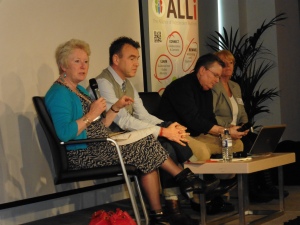
L-R: Peter Urpeth, John Prebble, Nicola Solomon and Debbie Young
Debbie Young of the Alliance of Independent Authors chaired a discussion with panellists Peter Urpeth of Scottish based Creative Agency, Emergents; John Prebble of Arts Council of England Literature Relationship Manager and Nicola Solomon of the Society of Authors. The theme was how to keep the cash coming in while you write. Grants, prizes, Public Lending Rights, mentoring schemes, partnerships with business development organisations and sponsorship are all potential sources of support for authors.

Dan and Rohan
Dan Holloway and Rohan Quine fired up the audience by speaking eloquently and poetically on diversity in literature. Both writers are superb examples of genre-busting talent and the audience responded to their rousing appeals for creativity and originality in publishing. Read Dan’s poem 'Because' and Rohan's stirring speech in their own sub-post in WWJ.

ALLi’s literary agent, Toby Mundy of TMA chaired a panel including Scott Beatty of Trajectory, book-scout Sharmaine Lovegrove of Dialogue Berlin & Fremantle Media, and Katie Donelan of BookBub to discuss how authors can sell more rights. Porter Anderson introduced SELF-e. Authors everywhere can sign up to get their ebooks into US libraries.

Sharmaine Lovegrove, Scott Beatty, Katie Donelan, Toby Mundy
Much talk centred on what self-publishing should learn from trade publishing. Rarely vice versa. Porter Anderson explored this key question with panellists Robert Caskie, Senior Agent at Peter Frazer Dunlop; Dr Alison Baverstock, Associate Professor, Department of Journalism and Publishing, Kingston University and Robin Cutler of Ingram Spark had an interesting discussion on how self-publishing affects trade publishers, editors, agents and bookshops?

Debbie Young and Piers Alexander introduced the new #Authors4Bookstores campaign. All writers and readers love bookstores and want to see at least one on every high street. This new campaign encourages and enables indie authors and bookstores to form mutually beneficial, supportive relationships.
  
Dr Alison Baverstock, Robert Caskie, Porter Anderson, Robin Cutler
Last session of IndieReCon saw Joanna Penn grill a range of successful indie authors, Rachel Abbott, Steena Holmes, CJ Lyons, Mark McGuinness and Nick Stephenson on their tactics, breakthrough moments and advice. There were interesting individual stories from each other, but also a collective agreement that the story was key - and making the effort to engage and retain readers vital.

Orna Ross & Porter Anderson wrapped up the conference with a look back at the last three years of ALLi and plans and hopes for the future. You can access all this and more via IndieReCon – talks, tips, ideas, videos and vast amounts of resources to peruse at leisure.


The Indie Author Fair at Foyles
Team Triskele
The last part of the day was IAF15 @Foyles, organised by Triskele Books. Fifty authors with books, balloons, goodies, quizzes and smiles welcomed browsers, bookclubbers, friends and most importantly the elusive band of readers.


The atmosphere was happy, friendly, communal and everything an indie author fair should be. Books were sold, contacts made, canapés devoured and wine consumed - and everyone went away happy and looking forward to the next IAF.

So, now we’re planning the next one. After a cup of tea.


Monday, 18 May 2015

The Oysters' Revenge - a poem by Brian Allgar

The Walrus and the Carpenter prepared an oyster-feast.
How well they lunched! They slurped and munched, they ravened like a beast.
The trick was how to disinter the oyster from its shell
While living still; it needed skill, and certain tools as well.

The Carpenter had brought his kit; they had no time to waste.
A chisel-twist, a turn of wrist, and lemon-juice to taste.
The oysters seemed devoid of wit, the merest fleshy swirl,
Yet each concealed within its shield an embryonic pearl.

From time to time, the Walrus heard a shrimp-like voice, but dafter:
“O Father, spare us! Or prepare us for the life hereafter.”
A moral qualm within him stirred: “Do oysters have a soul?”
“Beyond a doubt!” His friend reached out, and swallowed several whole.

“But do they suffer? Can they think? Do oysters, when they’re gone,
Know Heaven or Hell?” A silence fell; the Carpenter chomped on.
They’d brought some cooling wine to drink, a magnum of the Rhenish.
They quaffed the lot, but failed to spot some oysters that were greenish.

They stuffed themselves, quite unashamed, the weather fine and sunny,
Till, stomach clasped, the Walrus gasped: “I’m feeling rather funny.”
The Carpenter threw up, and blamed his fragile constitution.

No more was said; they both dropped dead from maritime pollution.


Winner of Flash 500 Humour Verse Category First Quarter 2015.

Carousel - a short story by Katharine Orton

There’s blood in my mouth. A metallic twang on my tongue from the split lip you gave me. You’re wearing the hood pulled up on your raincoat and my damp dress slaps against my shivering knees. I hug myself tight. For warmth, yes – and for courage. Because I’m not taking you back this time.

‘I’ll stay with Mum tonight,’ I say. ‘When I get back I want you gone.’ Our bodies are turned tactfully outwards, away from one another. There’s a fair at the seaside, today, and a carousel. Painted horses loom out of it. They bare wooden teeth; glare with manic eyes. It’s mesmerising.

We fled the house earlier like it was a crime scene. ‘To get some air,’ I’d said. I run my tongue over my lip again, reliving the pain. ‘Alice, please,’ you say. There’s a quiver in your voice.

‘Please, what?’ The wind makes me shiver – or maybe it’s adrenalin. I’m formidable now you’re weak. Now your rage has burned out and your fists have turned inwards again. I could be up high with the seagulls, watching us both, watching the carousel – buoyed on balmy foreign breezes.

I savour this feeling. It’s not often I get to be powerful.

‘Don’t do this,’ you beg. ‘I swear. I’ll never lay another finger on you.’

‘The problem isn’t your fingers,’ I say. ‘It’s your fists.’ The goad tastes delicious. The carousel thunders round, screaming.

You prize my arm away from my body. You have to wrench it. You hold my palm between both of yours, as if praying. ‘I’ll do anything, my love,’ you say. ‘Anything.’ A rush of sympathy floods me like anaesthesia. I struggle to resist. On the ride, children grip their slippery charges, faces fearful. Knuckles white.       

My father wasn’t like you – though he had other passions. He’d stalk into the room where my brothers and I played and slip his hand up Mum’s skirt, and she’d just stand there, frozen against the wall. As if her stillness meant we wouldn’t notice.

My own knuckles are the colour of chicken bones popped from their sockets.

I smell candy floss through the rain. What is it that made you this way, I wonder? Bruised, inside? Is it the ancient strap marks from your dead dad’s belt? The lashes from your mother’s tongue? I’ve seen the power of those.

You’re shaking now, as you grip my hand. Beside us, the carousel slows to a standstill. You sink to your knees. I could walk away. Leave you crumpled on the floor.

But something’s changed. I’m not your mother, after all. I’m not you. I can’t stomach hurting you for long. It’s the thing that makes me different that makes me stay.

I try to pull you to your feet and when you won’t rise, I crouch too. I kiss your tears with my bloody mouth. It hurts. When we get to our feet, the carousel has started again. New passengers. New fares. The same old ride.


Winner of Flash 500 First Quarter 2015.

Question Corner

Lorraine Mace answers readers’ queries.

Jefferson from Carlisle writes to ask how he can build tension into his novel: I’ve written a spy thriller (well I think it’s thrilling) but people who’ve read it say it doesn’t have enough tension. One of my writing friends says it needs cliff-hangers. I thought I’d done that, but maybe I haven’t done it right. Can you help?

Before we look at how to use cliff-hangers, let’s first outline what they are supposed to achieve. A cliff-hanger should leave readers in suspense, desperate to find out what happens next.

This means stopping a chapter or scene at a point where tension is high, but then switching to different scene or point of view. For example: A rapist and murderer picks his victims from joggers and follows them for a few weeks before turning up on their doorsteps, pretending to be from DHL parcel delivery. Sarah has just arrived home after her regular morning jog when the doorbell rings and the man on the doorstep claims to have a package to deliver.

At that point the chapter ends and the next one opens with a friend’s point of view, planning to meet Sarah for lunch, or move to the police point of view following up on an earlier rape/murder. The important thing is to leave the reader worrying about what has happened to Sarah.

However, cliff-hangers are not the only way to inject tension. Why not try adding in a few (or all) of the following?

Surprise, Surprise
Turn the tables from time to time. What about having a character who appears to be the bad guy, but is actually an undercover good guy? Or vice versa. What about having someone who appears to be a loving mother desperate to save her only child from drink and drugs, but is actually the reason the character went off the rails in the first place?

The longer you can make the reader think a character only wants the best for the protagonist, the greater the fear factor when the truth is revealed.

Put us in the villain’s head
If readers know things the protagonist doesn’t (especially if not knowing will put the protagonist in danger) it will add to the tension as we watch the hapless character walk into a trap.

Have an unstable character
If one of the characters is violent, or likely to break down without warning putting others in danger, readers will tense every time that character appears in a scene.

Hold back information
Don’t tell too much too soon. Drip feed information only as it is needed. Don’t feel you have to lay everything out so everyone can ‘get’ the story – trust your readers. Crime/thriller readers, in particular, are very good at following complex storylines with minimal information.

Phobias always add tension
Your protagonist probably has more than enough to cope with, but if readers know he or she also has a phobia that can really ramp up the tension. For example, someone adrift on a raft in tropical seas is scary enough, but add to that a pathological fear of sharks and the tension rises even before the first sight of a grey fin.

Time as an enemy
If there is all the time in the world to achieve a goal, there is little tension involved. However, if there is a time limit (four hours before a bomb explodes) the countdown adds to the fear factor. In Call it Pretending (the third D.I. Paolo Storey novel) a murder takes place every Friday and the killer leaves a note counting down the number of victims left alive. Six victims, six weeks, Paolo has limited time to solve the case and save lives.

Confined spaces
Put your characters into a confined space from which they are unable to escape (warehouse, boat, garage, loft). Even larger areas can become confined spaces if the protagonist has no way of getting out safely. For example, a forest can be a confined space if someone is being hunted.

Kill someone
If you kill off one of the good guys fairly early in the book, readers will worry even more about the others.

Twist before you go
If you can keep one final (plausible) twist in reserve for the last few pages readers will be reaching for your next book as soon as they put this one down (and they’ll buy the one after that and the one after that).

Obviously you don’t need to use all of these techniques, but if you pick the ones that will work best for your story, and incorporate them, I promise your readers won’t be complaining about lack of tension.

Lorraine Mace is the humour columnist for Writing Magazine and head competition judge for Writers’ Forum. She is a former tutor for the Writers Bureau, and is the author of the Writers Bureau course, Marketing Your Book. She is also co-author, with Maureen Vincent-Northam of The Writer’s ABC Checklist (Accent Press). Lorraine runs a private critique service for writers (link below). She is the founder of the Flash 500 competitions covering flash fiction, humour verse and novel openings.

Her debut novel for children, Vlad the Inhaler, was published in the USA on 2nd April 2014. The second in the trilogy is due out in July 2015.

Writing as Frances di Plino, she is the author of four crime/thriller novels featuring Detective Inspector Paolo Storey: Bad Moon Rising, Someday Never Comes, Call It Pretending and Looking for a Reason by Crooked Cat Publishing.